By Dmytro Klimchuk, CEO & Founder, mmore.agency | Last updated November 18, 2026 | Example pages checked November 18, 2026
Programmatic SEO for SaaS sounds like a cheat code: one template, one spreadsheet, thousands of pages. Sometimes it really works that way. Zapier and Wise both run huge organic channels on templated pages.
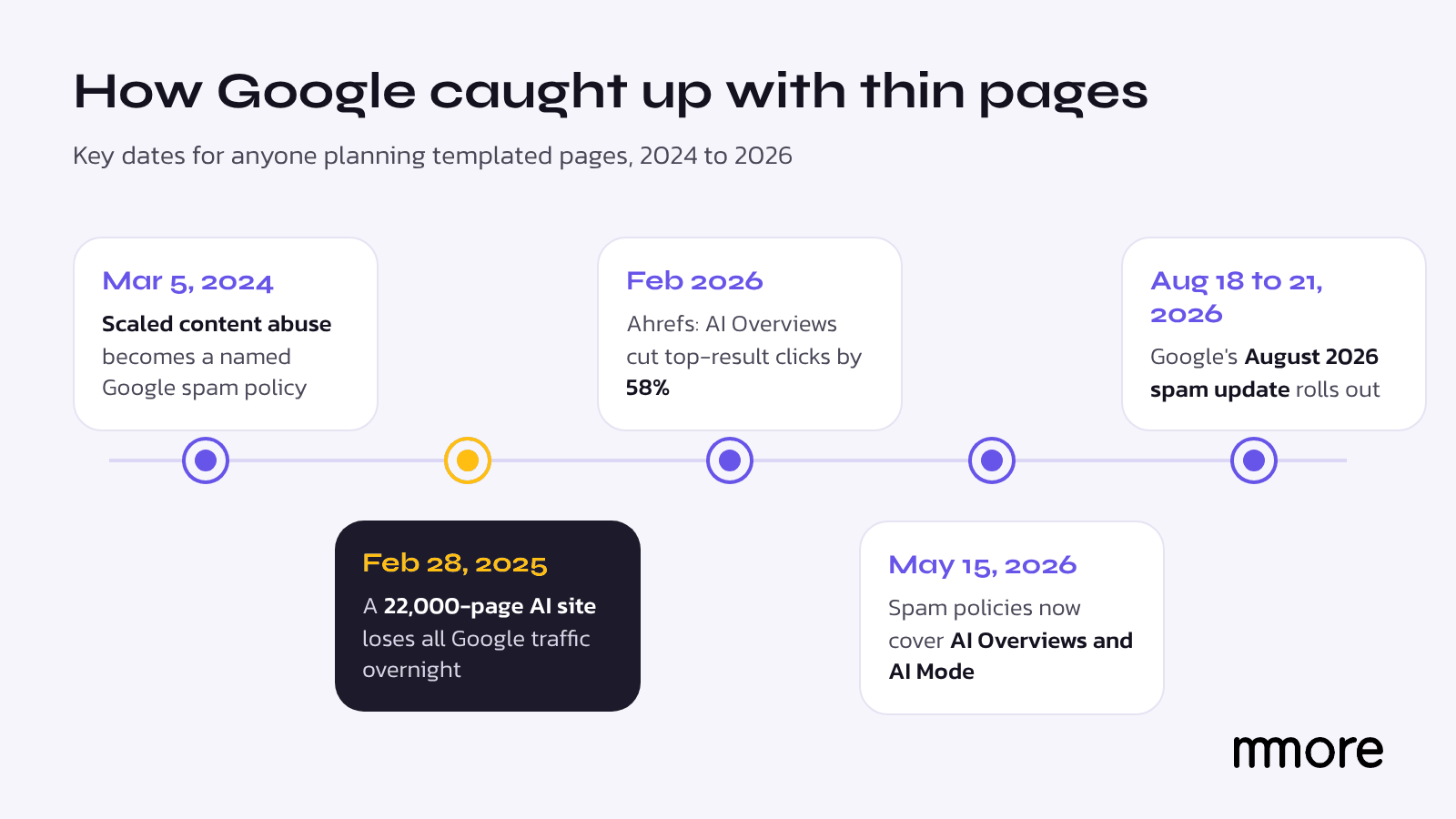
It also fails a lot. One startup published over 22,000 AI-written pages and watched its Google traffic drop to zero in one day. Google now describes that pattern by name in its spam policies.
This guide is for SaaS founders and marketing leads deciding whether templated pages are worth building. We measured how much of Zapier’s and Wise’s pages actually changes from page to page, took apart a public failure, and turned both into a four-question test you can run before you build anything.
Quick answer: Programmatic SEO works for SaaS when every page carries data that changes from page to page and answers a real search, like Zapier’s integration pages or Wise’s currency pages. It backfires when only the name changes, which Google calls scaled content abuse. Start with a pilot of 20 to 50 pages, not thousands.
Key takeaways
- Programmatic SEO uses one template and a dataset to publish many pages, each aimed at one long-tail search such as “HubSpot Slack integration”.
- The pages that work carry real data. When we checked on November 18, 2026, about 47% of the words on Zapier’s integration pages and 35% on Wise’s currency pages were unique to each page.
- Google’s spam policies treat mass-produced pages with little value as scaled content abuse, whether a person, a script or AI made them.
- Glossary and definition pages are the weakest pattern now. AI Overviews cut clicks to the top result by 58% when they appear, according to Ahrefs.
- Run the 4D Build-or-Skip Test (Demand, Data, Destination, Durability) before you build, then launch in batches and measure each one.
What is programmatic SEO for SaaS?
Programmatic SEO for SaaS is building many landing pages from one template and a structured dataset, where each page targets a different version of the same search. The template stays fixed. The data fills it: an app name, a currency pair, a competitor, an industry.
SaaS companies are well placed for it because they already own this kind of data. It sits in the product, the integrations list, the pricing engine and the help docs.
Programmatic doesn’t have to mean thousands of pages. A set of 30 competitor pages built from one template is programmatic SEO too. These are the patterns SaaS companies use most:
| Page pattern | Example search | Data that changes per page |
|---|---|---|
| Integrations | “HubSpot Slack integration” | Triggers, actions, setup steps, ready-made workflows |
| Alternatives and comparisons | “Asana alternatives” | Features, prices and limits your team checked |
| Converters and calculators | “USD to CAD” | Live rates or results from your own tool |
| Templates | “invoice template for contractors” | The actual template, ready to use |
| Use cases by industry | “project software for construction” | Customer examples, workflows, screenshots |
| Glossary | “what is net 30” | Usually nothing. The weakest pattern in 2026 |
Alternatives pages need extra care because they name competitors. Our guide to SaaS comparison pages covers how to build them without a penalty.
Does programmatic SEO still work in 2026?
Yes, programmatic SEO still works in 2026 when each page is the most useful answer to its search. Zapier lists 9,000+ apps in its app directory, each with its own integrations page. Wise publishes a converter page for currency pairs such as USD to CAD.
What these sets have in common isn’t size. Each page has something a person actually came for, and that something is different on every page.
We measured how much of each page is unique
To see what “unique” means in practice, we compared two pages from each site on November 18, 2026. We swapped out the app and currency names, then counted how many words sat in lines the other page didn’t have.
How much of a programmatic page is unique?
We compared two pages from each site and counted the words that change from page to page. Pick a page type.
Zapier: HubSpot + Slack (about 47% unique)
Changes on every page
- Ready-made workflows for this exact pair, like a Slack alert for every new HubSpot form submission
- Each app’s own triggers and actions
- How fast each trigger runs: instant or every 15 minutes on the free plan
Same on every page
- Platform claims like “9,000+ apps”, how Zapier works, sign-up buttons
Wise: USD to CAD (about 35% unique)
Changes on every page
- Live mid-market rate and a rate chart
- 30- and 90-day high, low and average
- Conversion tables in both directions
- Fees for this pair compared with banks such as Chase and Wells Fargo
Same on every page
- Account features, the debit card, how sending money works
Name-swap template (0% unique)
Changes on every page
- Only the name in the title, headings and sentences
Same on every page
- Everything else. This is the pattern Google’s spam policies call scaled content abuse.
How we measured, November 18, 2026: we compared the visible text of HubSpot + Slack with Gmail + Trello on Zapier (45% and 49% unique), and USD to CAD with EUR to GBP on Wise (35% and 34%). We replaced the app and currency names with placeholders, then counted words in lines the other page didn’t have. Charts and images aren’t counted.
About 47% of the text on Zapier’s integration pages was unique to the pair: ready-made workflows, each app’s triggers and actions, and how fast each trigger runs. Wise came in at 35%, and almost all of it is live data: the rate, 30- and 90-day highs and lows, conversion tables and a fee comparison with US banks.
The lesson isn’t a magic percentage. Two-thirds of a Wise page is shared text, and the pages still work, because the third that changes is exactly what the searcher wants. A page where only the name changes scores zero on this test, however long it is.
Thinking About Programmatic Pages for Your SaaS?
When does programmatic SEO backfire?
Programmatic SEO backfires when pages exist to rank rather than to help. Google’s spam policies define scaled content abuse as generating many pages “for the primary purpose of manipulating search rankings and not helping users.” The policy applies no matter how the pages are made.
The same policy page describes doorway abuse: sets of similar pages built for similar searches, like pages aimed at different cities that all funnel visitors to one place. A lot of “[service] in [city]” page sets fall straight into it.
Google has been tightening enforcement step by step since 2024. These are the dates that matter for anyone planning templated pages:
What a programmatic SEO failure looks like
The clearest public example is Tailride, an invoice tool that launched as GetInvoice in November 2024. Its founders later wrote openly about what went wrong.
- They started with about 300 retailer return policy pages, roughly 200 words each.
- Within a few months they had over 22,000 pages, including about 4,000 SWIFT code pages and 5,000 “what is” finance term pages.
- The process was automatic: scrape existing content, rewrite it with AI, publish. No person reviewed the pages.
- By February 2025 the site got about 130 organic clicks a day. On February 28, 2025, traffic dropped to zero overnight, with no message in Search Console.
- Over the next six months, indexed pages fell from over 20,000 to one: the homepage. The company rebranded in July 2025 and now publishes about one human-edited page a day.
What happened to 22,000 programmatic pages
Tailride’s own numbers, as its founders published them. Switch between the two dates.
Source: Tailride’s write-up of its Google penalty. Bar widths are not to scale, so small numbers stay visible.
Notice what was missing. None of those pages had data the company owned. Return policies and SWIFT codes already lived on retailer and bank websites, so the template added a rewrite, not a reason to visit.
Glossary pages also face a second problem. When an AI Overview appears, the top result now gets 58% fewer clicks, according to an Ahrefs study of 300,000 keywords published in February 2026. A definition is exactly what an AI answer gives away without a click. We cover that shift in more depth in traditional SEO vs LLM optimization.
The 4D Build-or-Skip Test
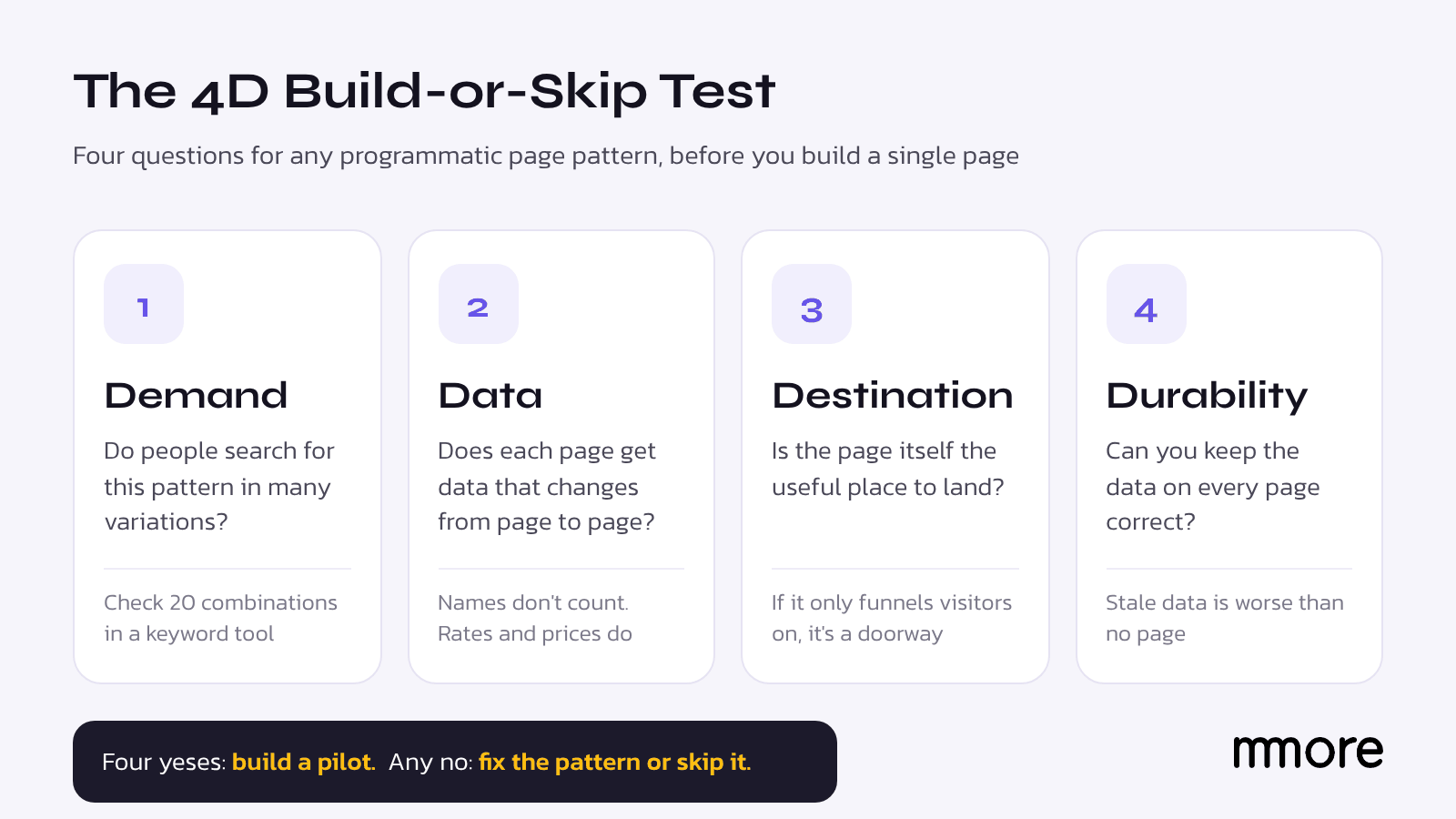
The 4D Build-or-Skip Test is four questions we ask about any page pattern before building it. Build only if all four answers are yes. One “no” means fix the pattern or drop it.
- Demand: Do people search for this pattern in many variations? Check a sample of 20 combinations in Ahrefs, Semrush or Google Keyword Planner. If most show no searches, skip it.
- Data: Does each page get data that changes from page to page? Names don’t count. Rates, triggers, prices, templates, screenshots and results do.
- Destination: Is the page itself the useful destination? If its main job is to push visitors to another page, it’s a doorway.
- Durability: Can you keep the data correct? Prices, limits and integrations change. A page with stale data is worse than no page.
Now put the test to work. The game below has six page ideas; make your call on each before you see ours.
Build it or skip it?
Six page ideas SaaS teams often consider. Make your call on each one, then see ours.
Integration pages
A page for each of your 60 integrations, with real triggers, setup steps and screenshots from your docs
You matched our call. We’d call it differently. Our call: Build
Build it. Each page has data only you have, and people search for “[your app] + [tool]” when they’re close to buying. This is Zapier’s pattern at a smaller scale.
Glossary
5,000 “What is [finance term]” pages written by AI from other sites’ definitions
You matched our call. We’d call it differently. Our call: Skip
Skip it. There’s no data you own, AI Overviews answer definitions without a click, and this is close to what sank Tailride.
Alternatives pages
“[Competitor] alternatives” pages for your 15 real competitors, with prices and limits your team checked
You matched our call. We’d call it differently. Our call: Build
Build it, carefully. Real checks make each page different. Be fair to competitors and keep the prices up to date.
City pages
“Project management software in [city]” for 300 cities where you have no office, customers or local features
You matched our call. We’d call it differently. Our call: Skip
Skip it. Nothing changes but the city name. Google’s spam policies list city pages that funnel visitors to one page as doorway abuse.
Calculator pages
“[Plan] cost calculator” pages powered by your own pricing engine, one per plan and team size
You matched our call. We’d call it differently. Our call: Build
Build it. A working tool on every page is the reason to click, and it’s hard for an AI answer to replace.
Template pages
400 “[Job title] project plan template” pages where only the job title changes and there’s no real template
You matched our call. We’d call it differently. Our call: Skip
Skip it, or build a few real ones. Template pages work when the template is real and different. A title swap isn’t a template.
0 of 6
matched our call
You already think like Google’s spam team. Run the 4D test on your own ideas next.
Close. The ideas you missed usually fail on Data: only the name changes.
Worth a second look. Ask of every idea: what changes on the page besides the name?
Programmatic SEO works when every page has something only you can show: real data, real setup steps, a real tool. It backfires the moment the template does the work and the data doesn’t. When a SaaS founder asks us for thousands of pages, our first question is always what changes on each one besides the name.
Dmytro Klimchuk, CEO & Founder, mmore.agency
How many programmatic pages should a SaaS build?
Most SaaS companies should build far fewer programmatic pages than their template allows. Multiply the variables and the count explodes, but only the combinations people search for, and that you have real data for, deserve a page.
Every page also needs a person to check it. At two minutes a page, reviewing 3,840 pages takes 128 hours, more than three working weeks. If you’re still deciding who would do that work, our breakdown of in-house vs agency SEO compares the real costs.
Page set planner: how many pages are worth building?
Example inputs for a project management SaaS. Change them to match your product.
Reviewing every possible page at 2 minutes each would take about 128 hours. The pages worth building take about 13.
Both shares are your estimates. Check demand for a sample of combinations in Google Keyword Planner, Ahrefs or Semrush before you build.
Our default is to start with the smallest set that passes the 4D test, often 20 to 50 pages, and grow from results. A few hundred strong pages beat thousands of thin ones, because Google’s spam systems can act on a whole site, not just its weakest pages.
What data makes a programmatic page worth indexing?
A programmatic page is worth indexing when it carries data a searcher can’t get from the page next to it. The more types of real data a page has, the less it leans on the template.
Tick the data your pages would actually have. Be strict: a sentence that only repeats the page name doesn’t count.
Unique data check: is your page pattern ready?
Tick the data that would change on every page in your set. The page name doesn’t count.
0
of 8 data types
Template only: skip itAdd real data before you build a single page.Thin: build a small pilot at mostTwo or three data types rarely carry a page on their own.Worth buildingStart with a pilot batch and measure.
The zones are mmore’s rule of thumb from planning SaaS page sets, not a Google threshold.
Most SaaS companies already own more of this data than they think. Integration pages can use real triggers and setup screenshots from your docs. Comparison pages can use prices and limits your team checked. Use case pages can use customer stories you already have permission to share.
How do you launch programmatic pages safely?
Launch programmatic pages in batches: a small pilot first, then bigger sets only for patterns that earn impressions. That way a weak pattern costs you 30 pages, not 3,000.
How to roll out programmatic pages
Four stages. Click a stage, and don’t move on until its checks pass.
Pilot: build 20 to 50 pages
Do
- Pick the pattern that passed the 4D test and use your best data
- Link every page from a real hub, like your integrations directory
- Have a person read every page in the pilot
Check before moving on
- Pages show up in the Page indexing report as indexed
- Few pages stuck in “Crawled, currently not indexed”
Measure: give it 4 to 8 weeks
Do
- Track impressions and clicks per page in Search Console
- Track sign-ups or demo requests from these pages
- Merge or remove pages with no impressions
Check before moving on
- Most pilot pages are indexed and getting impressions
- At least some pages bring clicks or sign-ups
Expand: grow only what worked
Do
- Build the next batch, 5 to 10 times the pilot, for passing patterns only
- Keep reviewing a sample of every batch
- Watch the rest of the site’s traffic for drops
Check before moving on
- The new batch is indexed at a similar rate
- Clicks per page hold up as the set grows
Maintain: keep the data true
Do
- Refresh data on a schedule: prices, limits, integrations
- Prune pages that stay at zero impressions
- Add pages when your product adds data
Check before moving on
- No stale prices or dead integrations on live pages
- Pages keep earning impressions, not just existing
Google Search Console’s Page indexing report shows early whether Google wants the pages. Watch three statuses:
- Discovered, currently not indexed: Google knows the URL but hasn’t crawled it yet.
- Crawled, currently not indexed: Google fetched the page and chose not to index it. Google says this status is common, but if most of a pilot batch sits here, the pattern is the problem.
- Duplicate without user-selected canonical: Google sees the page as a copy of another page and picked the other one.
Internal links matter too. Link each page from a real hub, like an integrations directory, so it sits in a structure people can browse. Google’s doorway rules specifically mention similar pages that look more like search results than a clear, browsable hierarchy.
How mmore.agency approaches programmatic SEO
At mmore.agency, programmatic pages are one possible priority, not a package we sell by the thousand. We don’t work from a fixed monthly checklist. Each month we review rankings, traffic and sign-ups, then pick the tasks with the biggest impact.
For a SaaS client, one month might go to building 30 integration pages from the product’s own data. The next might go to fixing pages that compete with each other, or to a comparison page against the competitor sales hears about most. If the data says templated pages aren’t the best next step, we don’t build them.
Every month has three parts: priority tasks chosen from data, a fixed amount of new and refreshed content, and a report on what we did, why, and what moved.
SaaS programs start at US$3,000 a month (about C$4,000) with no locked contracts, and our SaaS SEO pricing guide shows how that compares. For a real result, see how procurement software company Tradogram grew new organic users by 370%. mmore is an SEO agency based in Calgary working with SaaS and B2B companies across Canada and the US, and our SaaS SEO and AI search service explains the program in detail.
Get a Free SaaS SEO Audit Before You Build
We’ll check which page patterns your SaaS has real data for, how your current pages are indexed, and where you stand in Google and AI search.
Frequently asked questions
Is programmatic SEO considered spam by Google?
No, programmatic SEO isn’t spam by itself. Google’s spam policies target pages made mainly to manipulate rankings, whether a person, a script or AI made them. Integration, converter and template pages with real data on each page are allowed, and many rank well.
Can you use AI to create programmatic SEO pages?
You can use AI to help, but not as the only source of content. Google’s scaled content abuse policy names using generative AI to create many pages without adding value. Use AI to format and summarize your own data, and have a person review a sample of every batch.
Why are my programmatic pages not getting indexed?
Usually because Google sees the pages as too similar or not useful enough. Open the Page indexing report in Search Console. If many pages from one template sit in “Crawled, currently not indexed”, add unique data, merge similar pages or remove the weakest ones.
How many pages should a programmatic SEO pilot have?
20 to 50 pages is a good pilot for most SaaS sites. That’s enough to see a pattern in indexing and impressions, and small enough to fix by hand. Give the pilot 4 to 8 weeks before deciding to expand.
Is programmatic SEO worth it for a small SaaS?
It can be, if you own data for each page. A small SaaS with 30 integrations can build 30 strong integration pages. Without that data, a handful of hand-written comparison and use case pages usually does more.
Not sure if templated pages fit your SaaS?
Get a free website audit. We’ll run the 4D test on your page ideas, check what’s already indexed, and show where you stand in Google and AI search. If mmore.agency isn’t the right fit, we’ll say so.
About the author: Dmytro Klimchuk is the CEO and founder of mmore.agency, an SEO and AI search agency based in Calgary and working with clients across Canada and the US. He has been doing SEO for more than 12 years and leads strategy for SaaS, B2B, local and nationwide SEO and AI search campaigns. Connect with Dmytro on LinkedIn.