By Dmytro Klimchuk, CEO & Founder, mmore.agency | Last updated November 17, 2026
SaaS comparison pages are some of the best-converting pages a software company can publish. Someone searching “HubSpot alternatives” or “Asana vs monday” already knows the category and is close to switching. Win that search and you meet a buyer at the exact moment they’re deciding.
They’ve also become one of the riskiest pages to get wrong. Since January 2026, sites that published dozens of “best X” lists ranking their own product first have lost large parts of their blog traffic. Some lost most of it.
This guide is for SaaS founders and marketing teams who want the upside of comparison and alternatives pages without becoming the next cautionary tale. It includes our own check of who ranks for these searches right now, and a checklist for building pages that hold up.
Quick answer: Yes, SaaS comparison and alternatives pages still work in 2026. In our check of 50 top results, 58% were written by software vendors. The pages that hold up disclose who wrote them, say where competitors win, show first-hand evidence and stay few. Pages made from a template at scale, each ranking you first, are the ones getting hit.
Key takeaways
- Comparison pages are not dead. Vendors wrote 29 of the top 50 results we checked for five “[tool] alternatives” searches.
- What Google started demoting in 2026 is self-promotional lists at scale, especially thin ones that rank the publisher first by default.
- Being cited is not the same as being recommended. Google’s AI Overviews often cite self-serving lists and then recommend a competitor.
- Honest pages win twice: they hold their rankings, and they give AI tools a fair summary of when to pick you.
- Start with 3 to 5 deep pages for the competitors your buyers actually compare you with, not a page for every tool in the category.
What are SaaS comparison and alternatives pages?
SaaS comparison and alternatives pages help a buyer choose between named products. They target searches that include a competitor’s name, which is why they convert well and why they invite scrutiny.
| Page type | Example search | What the buyer wants |
|---|---|---|
| Versus page | “Asana vs monday” | A clear verdict on two specific tools, by use case |
| Alternatives page | “Zendesk alternatives” | A short list of credible options, and who each one suits |
| Best-of list | “best help desk software” | A ranked or grouped list of the whole category |
| Switching page | “move from Mailchimp to [your tool]” | Proof the switch is worth it, plus how to migrate |
All four can rank and get cited by AI tools. They carry different risk, though. A versus page about you and one rival is easy to make fair. A best-of list where you rank yourself first is the format that drew the 2026 demotions.
Why are comparison pages worth the risk?
Comparison pages reach buyers late in the decision and they feed AI answers. In an Ahrefs study of 26,283 source URLs cited by ChatGPT, “best” lists were the most-cited page type, at 43.8%, including lists where brands ranked themselves first.
That makes comparison content one of the few page types that works in both Google and AI search. You can read the Ahrefs research on best lists for the full method. The catch is what happens when everyone in a category does the same thing at once.
What happened to self-promotional listicles in 2026?
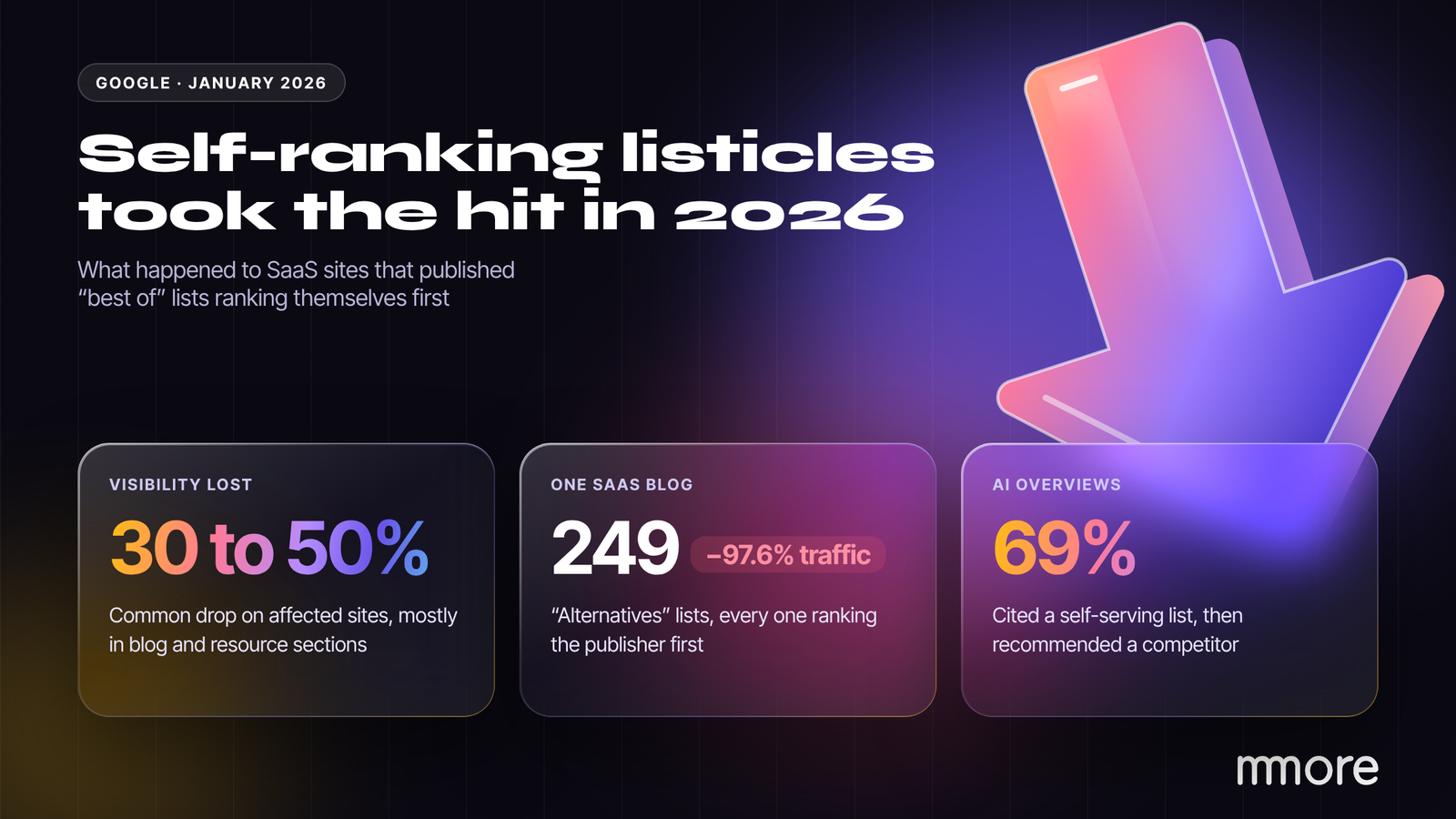
Around January 21, 2026, Google rankings swung sharply without an announced update, and sites heavy with self-promotional “best of” lists were hit hardest. SEO consultant Lily Ray reported visibility losses of 30% to 50% as common, mostly in blog and resource sections, while core product pages often held.
The pattern across affected sites was scale. Reported examples had dozens to hundreds of self-ranking lists. The most extreme case, as reported by PPC Land, was ClickUp: an analysis of its blog found 249 “[competitor] alternatives” lists, all ranking ClickUp first, on a site that lost 97.6% of its search traffic.
There is a second problem that matters for AI search. Lily Ray also found that Google’s AI Overviews often cited self-serving lists while recommending competitors instead, 69% of the time in her study. A list can earn you the citation and still send the buyer to someone else.
Who ranks for “[tool] alternatives” searches right now?
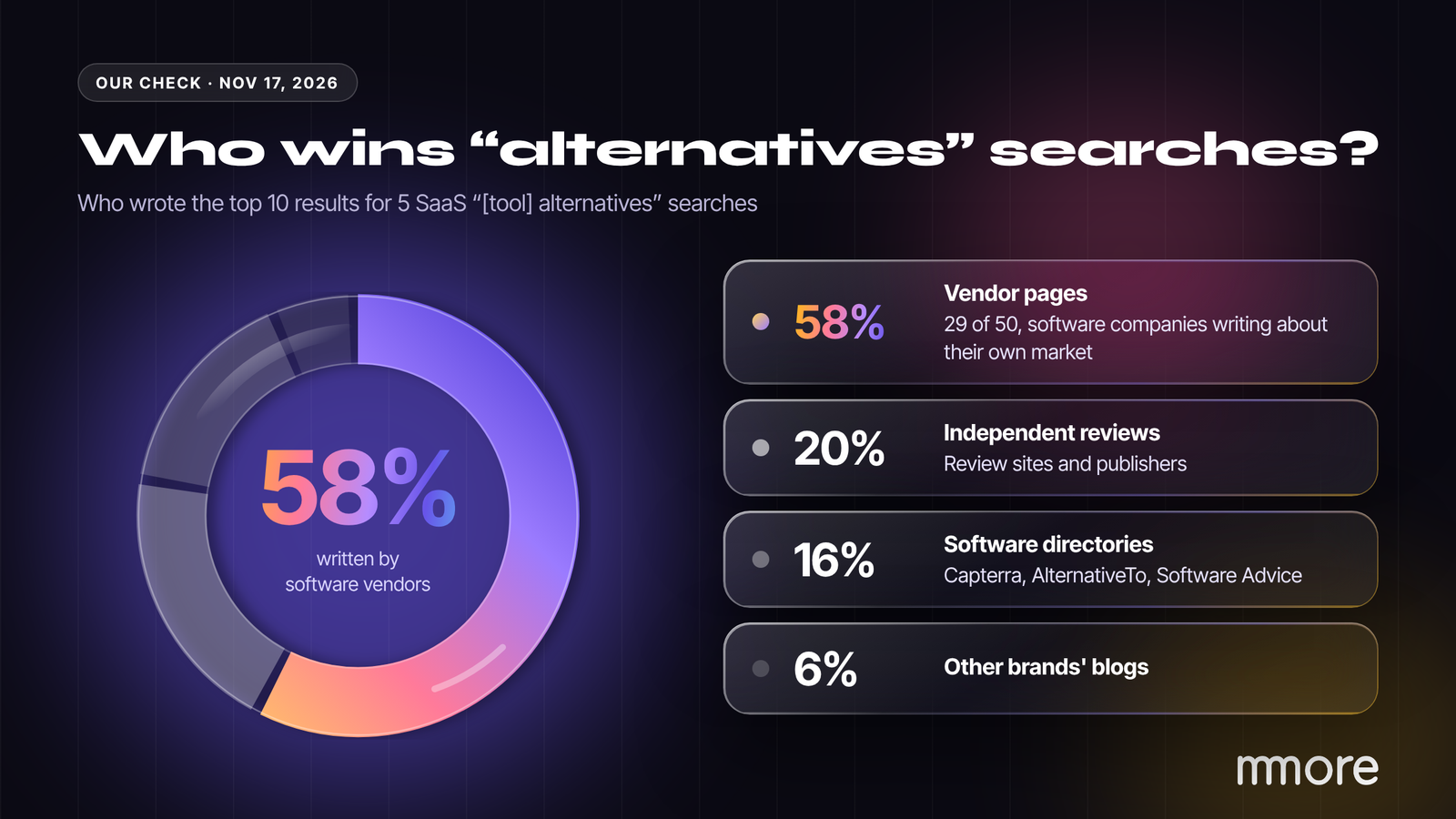
Software vendors still own most of these results. When we checked the top 10 web results for five popular SaaS alternatives searches on November 17, 2026, vendors wrote 29 of the 50 results, or 58%. Independent review sites and publishers took 20%, software directories 16%, and other brands’ blogs 6%.
| Search | Vendor pages in the top 10 | Everything else |
|---|---|---|
| HubSpot alternatives | 6 | 4 (review sites, a directory) |
| Asana alternatives | 4 | 6 (directories, publishers, another brand) |
| Mailchimp alternatives | 4 | 6 (directories, publishers, another brand) |
| Zendesk alternatives | 8 | 2 (publishers) |
| Calendly alternatives | 7 | 3 (directories, another brand) |
| Total | 29 of 50 (58%) | 21 of 50 |
Many of those vendor pages put their own product first. So the format itself isn’t what Google is punishing. The sites that dropped had something else in common: a high volume of thin, look-alike lists that offered little a reader couldn’t get elsewhere.
Two more things stood out. Directories like Capterra and AlternativeTo took 16% of the spots, so being listed and reviewed there matters as much as your own page. And the Zendesk results were almost all vendors, which tells you how crowded a mature category gets.
Find Out Who Wins Your Competitor Searches
How to build comparison pages that hold up
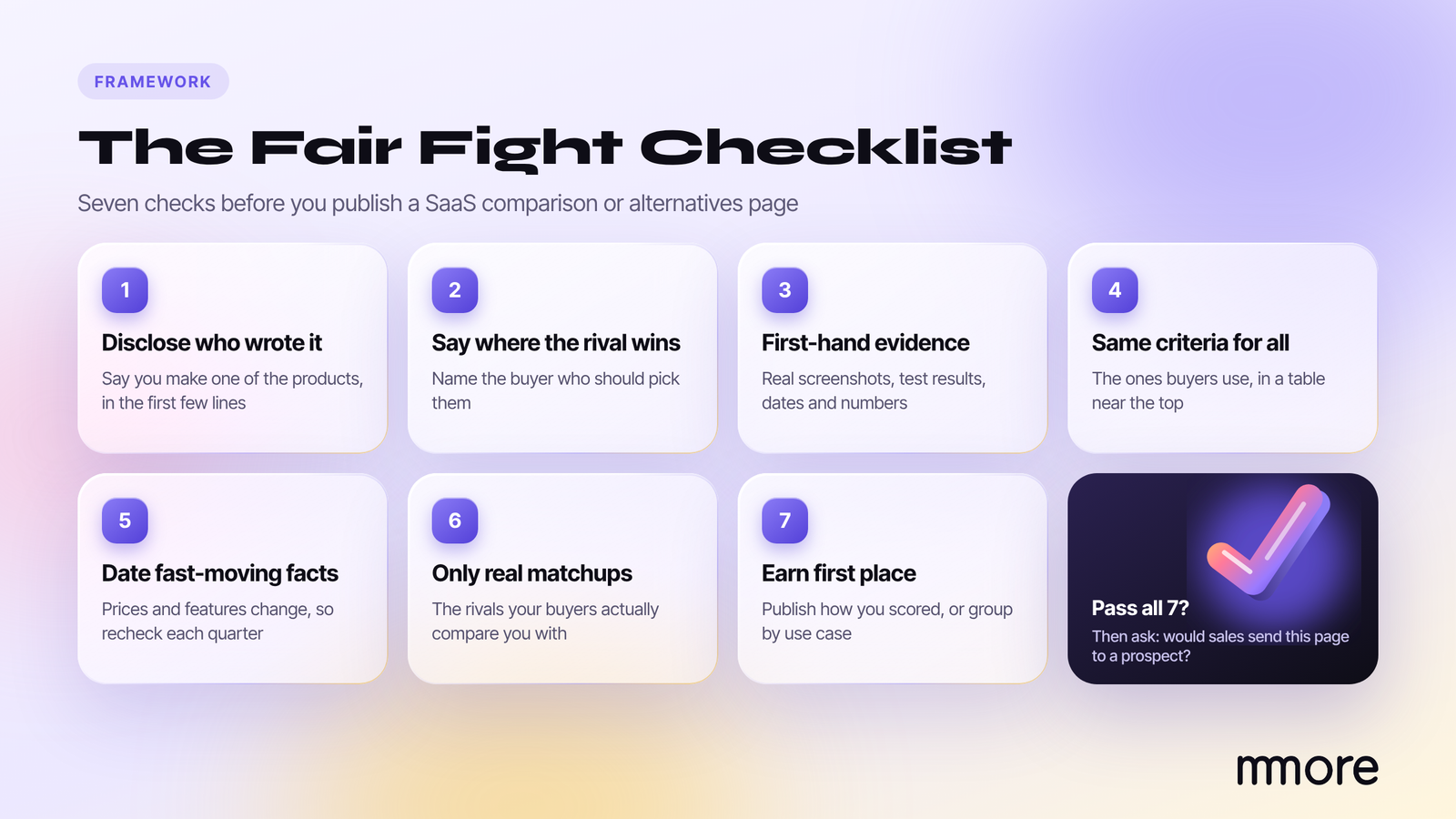
Build each comparison page as if a skeptical buyer, not a search engine, will judge it. Google’s guidance on writing high-quality reviews asks for first-hand evidence, clear criteria, honest pros and cons, and ranked lists that are useful on their own. We turn that into a seven-point check we call the Fair Fight Checklist:
- Disclose up front that you make one of the products, in the first few lines, not in a footnote.
- Say where the competitor wins, and name the buyer who should pick them. This is the single strongest trust signal on the page.
- Show first-hand evidence: screenshots from a real account, test results, dates, and numbers you can stand behind.
- Compare on the criteria buyers use, the same ones for every product, in a table near the top.
- Date every fast-moving fact. Prices and features change; write “checked November 2026” and recheck each quarter.
- Keep it to real matchups. Cover the competitors your buyers actually compare you with, not every tool in the category.
- Earn first place, don’t assume it. On a best-of list, publish how you scored each option, or group products by use case instead of ranking.
| Do | Don’t |
|---|---|
| Write “X vs us” pages for your 3 to 5 most common competitors | Spin up 200 “alternatives” pages from one template |
| Explain who should choose the competitor | Pretend the competitor has no strengths |
| Use your own screenshots, data and dated prices | Copy feature lists from the competitor’s site |
| Group options by use case (“best for small teams”) | Put yourself at #1 on every list by default |
| Update pages every quarter | Leave 2023 prices on a 2026 page |
A comparison page outline you can copy
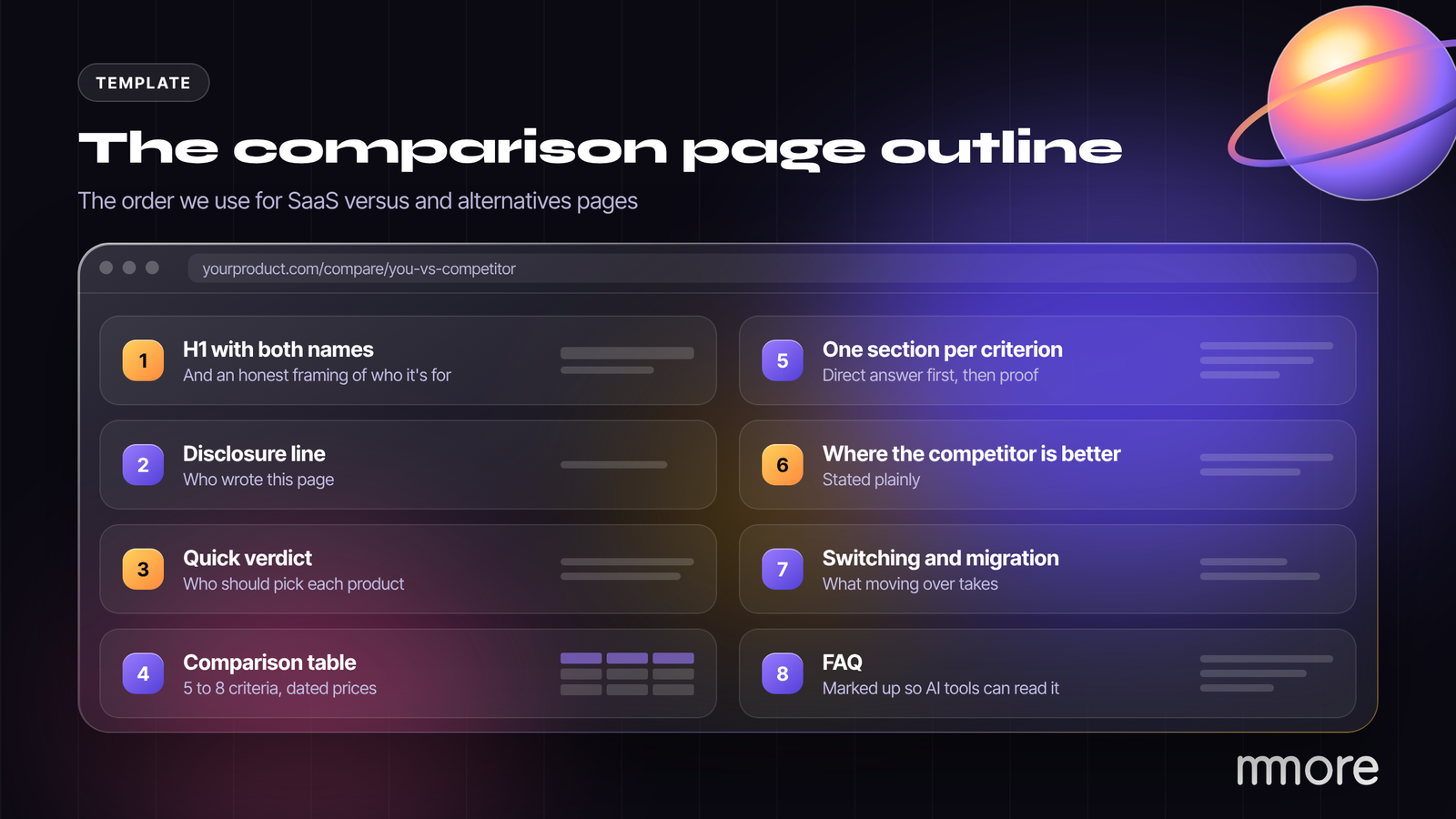
A strong versus or alternatives page answers the buyer’s decision in the first screen, then backs it up. This is the order we use:
- H1 with both names and the honest framing, for example “Asana vs monday: which fits a 20-person agency?”
- Disclosure line saying who wrote the page.
- Quick verdict: 2 or 3 sentences on who should pick each product.
- Comparison table: 5 to 8 criteria, same for both, with dated prices.
- One section per criterion, each opening with a direct answer and backed by screenshots or data.
- Where the competitor is better, stated plainly.
- Switching and migration: what moving over takes, and what you help with.
- FAQ with the follow-up questions buyers ask, marked up so AI tools can read them.
For a real example of bottom-of-funnel pages paying off, see how procurement software company Tradogram grew organic transactions by 398%.
How many comparison pages should a SaaS site have?
Start with 3 to 5 deep comparison pages for the competitors your buyers name most often, and add more only when sales calls or search data show real demand. The sites hit in 2026 had dozens to hundreds of near-identical lists.
A simple test before you publish one: would your sales team send this page to a prospect who is comparing you with that competitor? If not, it isn’t ready, however well it might rank.
How do comparison pages perform in AI search?
AI tools cite comparison pages heavily, but they decide who to recommend from many sources at once. A fair page that explains when to choose you gives ChatGPT, Perplexity and Google’s AI Overviews a clean, quotable reason to name you for the right buyer.
That’s also why third-party lists matter so much. Directories, review sites and independent roundups carry more weight in AI answers than your own page alone. Our guide to traditional SEO vs LLM optimization explains how those signals differ, and our AI search optimization (GEO and AEO) service covers how we build them.
How mmore helps SaaS companies with comparison pages
At mmore.agency, we plan, write and maintain comparison and alternatives pages for SaaS and B2B companies, as part of one program that covers Google and AI search. Every page goes through the Fair Fight Checklist before it goes live. It covers:
- Research into the competitor searches and AI prompts your buyers actually use
- Versus, alternatives and switching pages for your 3 to 5 real matchups
- First-hand evidence on every page: product screenshots, dated prices and input from your team
- Mentions on the directories, review sites and lists that AI tools cite
- Quarterly updates so prices and features stay current
- AI visibility tracking across ChatGPT, Perplexity, Gemini and Google AI Overviews
Programs start from US$3,000 (about C$4,000) a month. Our breakdown of SaaS SEO pricing in 2026 shows what that buys across the market.
For proof, see how procurement software company Tradogram grew new organic users by 370% and organic transactions by 398%. We’re based in Calgary and work with SaaS and B2B companies across Canada and the US. Read more on our SaaS SEO and AI search page.
Frequently asked questions
Are comparison pages bad for SEO in 2026?
No. Comparison pages still rank well when they’re honest and useful. What Google demoted in 2026 was self-promotional lists at scale, especially thin pages that ranked the publisher first by default.
Should I rank my own product first on an alternatives page?
Only if you can show why with a published scoring method. A safer approach is to group options by use case, or to write versus pages that say clearly which buyer should choose the competitor.
How often should I update comparison pages?
Recheck prices and key features at least every quarter, and update the visible date when something really changes. Out-of-date prices are one of the fastest ways to lose a reader’s trust.
Do alternatives pages help with AI visibility?
Yes, if they’re fair. AI tools cite comparison content often, but they also compare it with directories and independent reviews. A page that matches what those sources say is more likely to be quoted.
How many comparison pages should we start with?
Start with 3 to 5 pages for the competitors your buyers mention most on sales calls. Add more only when search data or deals show real demand for a specific matchup.
Get Your Free SaaS SEO Audit
We’ll show you which competitor searches your buyers use, how your pages stack up in Google and AI search, and which comparison pages to build first.
About the author: Dmytro Klimchuk is the CEO and founder of mmore.agency, an SEO and AI search agency based in Calgary and working with clients across Canada and the US. He has been doing SEO for more than 12 years and leads strategy for SaaS, B2B, local and nationwide SEO and AI search campaigns. Connect with Dmytro on LinkedIn.