 Dmytro KlimchukCEO & Founder, mmore.agencyExpertise
- SaaS and B2B SEO
- AI search (GEO and AEO)
- Local SEO and Google Maps
- Content strategy and SEO reporting
Last updated November 19, 2026AI answers collected November 19, 2026
More SaaS buyers now ask ChatGPT for a shortlist before they ever open Google. If your product isn’t in that answer, you aren’t on the list.
This guide shows how to get recommended by ChatGPT and the other AI tools buyers use. It’s for SaaS founders and marketing leads. Instead of repeating the usual tips, we asked ChatGPT, Gemini and Google AI Overviews 60 real software buying questions and looked at which brands they named and which sources they leaned on.
The answers point to five places your brand needs to show up. Most of them are not your own website.
Quick answer: To get your SaaS recommended by ChatGPT, make sure AI crawlers can read your site, publish clear pages for the exact questions buyers ask, and get named on the sources AI tools cite: Reddit threads, YouTube videos, “best tools” articles and review sites. In our test of 180 AI answers, those outside sources mattered as much as the brand’s own pages.
Key takeaways
- ChatGPT and other AI tools build their shortlists from many sources, and most of those sources are not the brand’s own website.
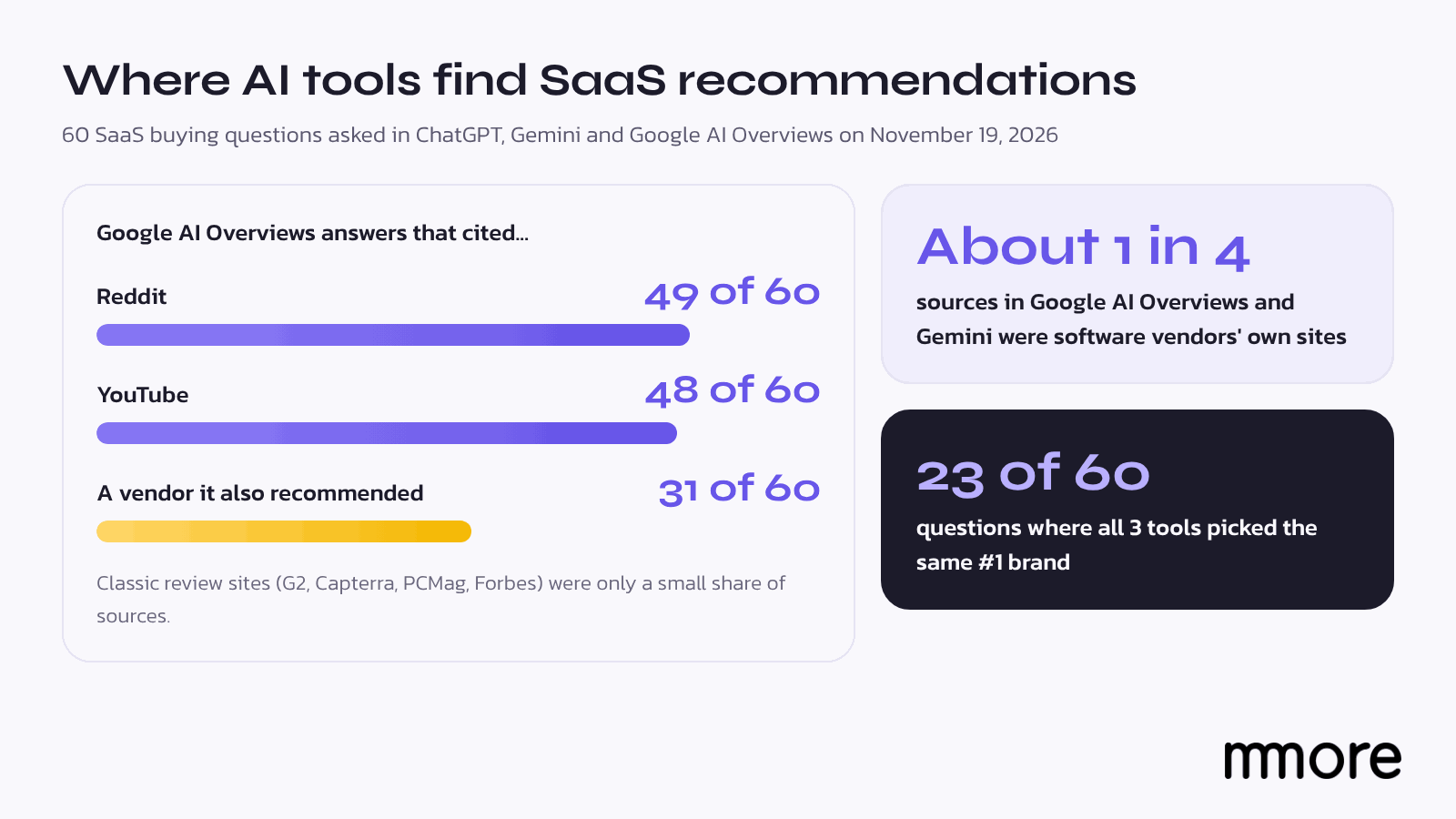
- In our test, Google AI Overviews cited Reddit in 49 of 60 answers and YouTube in 48 of 60.
- The tools disagree a lot: ChatGPT, Gemini and Google AI Overviews picked the same #1 brand on only 23 of 60 questions.
- Your own site still counts. About a quarter of the sources Google AI Overviews and Gemini cited were software companies’ own pages.
- Track answers to a fixed set of buyer questions every month, because one test in one tool tells you very little. Our guide to measuring AI search visibility shows which numbers to track.
Why does it matter if ChatGPT recommends your SaaS?
It matters because AI chatbots now decide which products make many buyers’ shortlists. In G2’s March 2026 survey of 1,076 B2B software buyers, 51% said they start software research in an AI chatbot more often than in Google, up from 29% a year earlier.
The same G2 research found 71% of buyers rely on AI chatbots at some point in their research. A brand that isn’t named in those answers loses the deal before anyone visits its website.
Being recommended is also different from ranking. A page can rank on Google and still never be named by ChatGPT, which is why we cover both in our guide to traditional SEO vs LLM optimization.
What we tested: 60 buying questions in 3 AI tools
We asked ChatGPT, Gemini and Google AI Overviews 60 questions a SaaS buyer would actually type, then recorded every brand named and every source cited. That gave us 180 answers to compare.
- Questions: 5 per category across 12 categories, including CRM, project management, email marketing, accounting, HR and payroll, customer support, SEO tools, procurement and AI app builders. Examples: “Best CRM for a 10-person B2B startup” and “Zendesk alternatives”.
- Setup: all runs on November 19, 2026, logged out, one fresh chat or search per question, from a browser in Calgary.
- What we counted: the brands in each answer, in order, and the sources each tool showed.
- Limits: it’s one day and one location, and AI answers change from run to run. We’re adding Perplexity next and will update the numbers.
The headline numbers: the three tools named 266 different brands across 180 answers. 93 of them were named only once, and 96 were named by only one of the three tools. On average, only 3.35 brands showed up in all three answers to the same question.
Two more patterns stood out. First, every tool localized its answers to Canada, even when the question didn’t mention a country. “Best business bank account for startups” got Canadian banks from all three. Your buyers in Toronto and in Texas may see different shortlists.
Second, the big categories are hard to break into. Accounting was the tightest: only 14 brands were named across all its answers, and QuickBooks came first in 12 of 15. Procurement was the widest, with 45 brands. A niche or a clear use case is a much easier way in than “best CRM”.
Tight vs open categories
How many different brands the three tools named across 15 answers per category.
Accounting
QuickBooks was named first in 12 of 15 answers. Hard to break in.
Procurement
45 different brands across 15 answers. Much more room for a newer name.
Circle size shows the number of brands named. Source: our test of ChatGPT, Gemini and Google AI Overviews, November 19, 2026.
What surprised me most was how little the tools agree. ChatGPT, Gemini and Google picked the same top brand on only 23 of 60 questions. There’s no single ‘AI ranking’ to win, so you have to show up in many places at once.
Dmytro Klimchuk, CEO & Founder, mmore.agency
How does ChatGPT decide which SaaS products to recommend?
ChatGPT recommends products that it finds named, again and again, in sources it trusts for that exact question. When it searches the web, it reads a set of pages, then names the brands those pages agree on.
That’s why the same products keep coming up. HubSpot was the most named brand in our test, with 36 mentions across CRM, email, customer support, newsletter and website questions. It is written about everywhere, in almost every context.
Google says the same thing in its own way. Its guide to generative AI features in Search says unique, useful content matters most, that fake mentions across the web don’t help, and that you don’t need special AI files like llms.txt for Google.
How to get recommended by ChatGPT: 7 steps
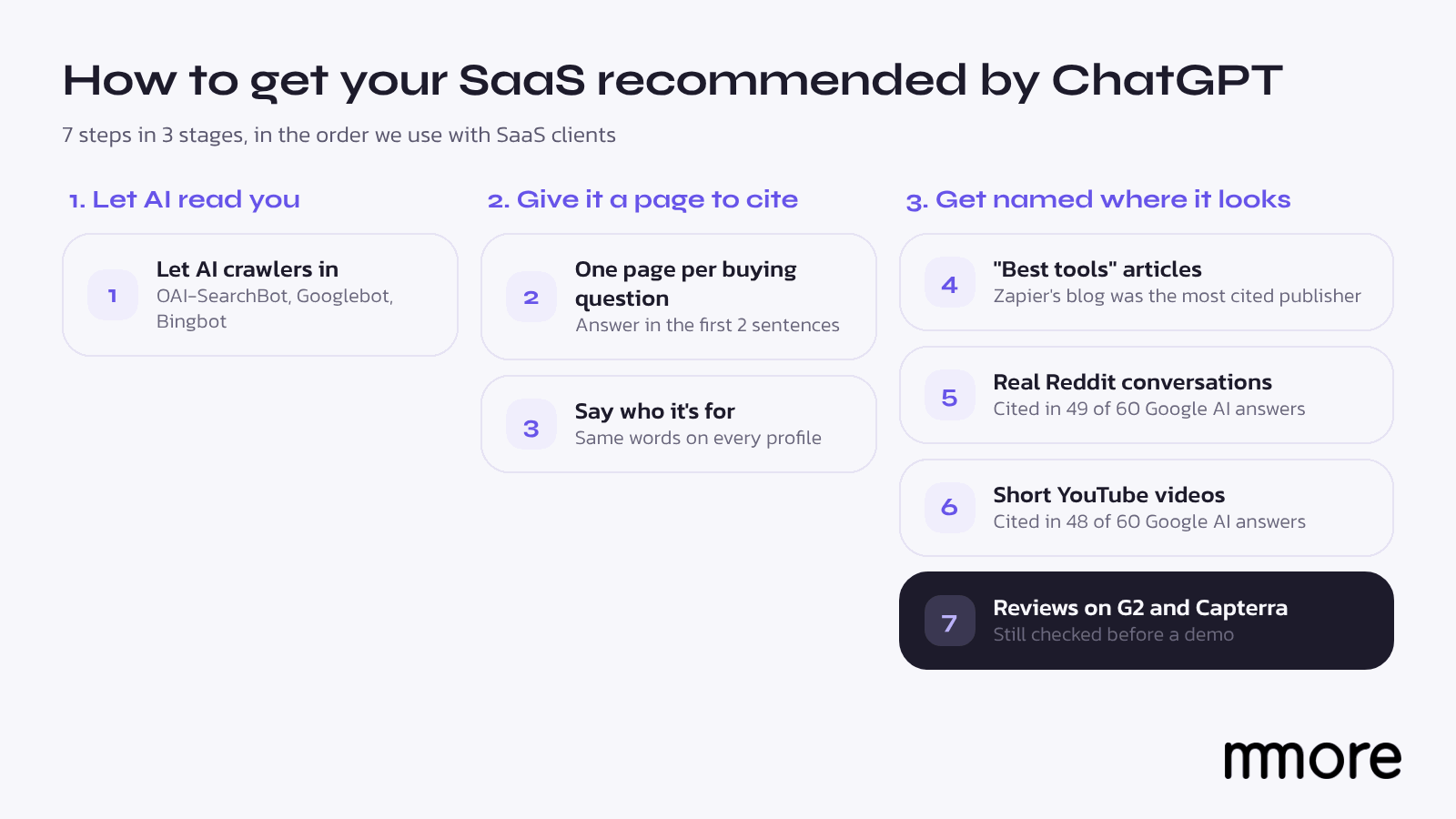
These steps follow the order we use with SaaS clients: first make sure AI tools can read you, then give them a clear page to cite, then get named where they look.
1. Let AI crawlers read your site
Check that your robots.txt, firewall and CDN don’t block OpenAI’s search crawler, OAI-SearchBot. OpenAI’s publisher FAQ says pages that block it won’t be shown in ChatGPT search answers.
Do the same for Googlebot and Bingbot. Many security plugins and Cloudflare rules block bots by default, and nobody notices until the brand is missing from AI answers.
Know which bot does what. Blocking GPTBot only keeps your pages out of OpenAI’s model training. Blocking OAI-SearchBot keeps you out of ChatGPT search answers, which is usually not what a SaaS company wants.
Can AI crawlers read your site?
Paste your robots.txt (find it at yoursite.com/robots.txt) and check the crawlers behind ChatGPT, Google, Bing, Perplexity and Claude in one click.
2. Write one clear page for each buying question
Make a page for each question your buyers ask, like “best [category] for [audience]”, “[competitor] alternatives” and “[your product] vs [competitor]”. Answer the question in the first two sentences, in plain words.
AI tools quote short, specific claims. “Built for 10 to 50-person B2B sales teams, from $29 per user” is easy to repeat. “The all-in-one platform for modern teams” says nothing an answer can use. Our guide to SaaS comparison pages shows how to write these without getting penalized.
3. Say exactly who your product is for
State your category, your audience and your use case the same way on your site, your G2 and Capterra profiles, LinkedIn, Crunchbase and your docs. AI tools match a product to a question by these words.
Our study showed why this matters. The tools agreed on the #1 brand for only 23 of 60 questions, so each tool is making its own match between products and questions. The clearer your words, the easier that match is.
4. Get into the “best tools” articles AI tools cite
Find the listicles and roundups that AI tools already cite for your questions, then ask to be included. Zapier’s blog was the most cited single publisher across the three tools in our test.
Start with the pages that rank on Google for your category and show up as sources in AI answers. Offer the writer something useful: a free account to test, real pricing, a customer example. Never pay for fake reviews or placements that hide that they’re paid.
5. Be part of real Reddit conversations
Reddit was the most cited source for Google AI Overviews in our test, so it’s worth a plan. Answer questions in your category’s subreddits from a named, honest account, and say you work for the company.
Help first. A founder explaining how to choose a tool, including when a competitor fits better, earns trust and mentions. Posting your own link in every thread gets you banned.
6. Publish short YouTube videos for buying questions
YouTube appeared in 48 of 60 Google AI Overviews answers. Make simple videos for the same questions as your pages: a 3-minute product walkthrough, a setup guide, an honest comparison with a competitor.
Use the question in the title and description, and add chapters. You don’t need a studio. A clear screen recording works.
7. Collect reviews on the sites buyers trust
Ask happy customers to review you on G2, Capterra or the review site that matters in your category. Review sites were a smaller share of AI sources than we expected, but buyers still check them before they book a demo.
Reviews also give AI tools the words customers use, like “easy to set up” or “great for small teams”. Those phrases often show up in AI answers.
Want to Know Where Your SaaS Shows Up in AI Answers?
Where should you start? The 5-Source Gap Check
Start with the source where your competitors show up and you don’t. We call this the 5-Source Gap Check: for your top 10 buying questions, note which of the five sources the AI tools cite, and whether your brand is on them.
The 5-Source Gap Check
Ask your top buying questions in ChatGPT, Gemini and Google, then mark each source: does your brand show up there?
Reddit threads
Cited in 49 of 60 Google AI Overviews answers
Search “[your category] reddit” and read the top threads. Which brands do people recommend, and why?
YouTube videos
Cited in 48 of 60 Google AI Overviews answers
Search your top buying questions on YouTube. Does your product have a walkthrough or comparison video?
Your own pages
About a quarter of Google and Gemini sources
Can AI crawlers read your key pages, and is there a page for each buying question that answers it in two sentences?
“Best tools” articles
Zapier’s blog was the top single publisher
List the articles AI tools cite for your questions and note which ones leave you out.
G2, Capterra and review sites
A small share of AI sources, still checked by buyers
Is your profile in the right category, with recent reviews and pricing that matches your site?
Mark each source to see your biggest gap.
Fix the biggest gap first instead of doing a little of everything. One source done well beats five done halfway.
Common mistakes that keep SaaS brands out of AI answers
The most common mistake is writing only about yourself on your own site and expecting AI tools to find you. Here are the others we see most:
- Blocking AI crawlers by accident with a security plugin or CDN rule.
- Vague positioning, so AI tools can’t tell which question your product answers.
- Fake reviews or paid mentions that hide that they’re paid. Google says inauthentic mentions don’t help, and they put your reputation at risk.
- Mass AI-written pages for every keyword variation. Our post on programmatic SEO for SaaS shows what happens when the template does the work and the data doesn’t.
- Testing once and giving up. AI answers change from run to run. One missing mention proves nothing.
How do you know if it’s working?
You know it’s working when your brand shows up in more answers to the same fixed set of questions, month after month. Pick 20 to 30 buying questions, run them in ChatGPT, Gemini, Perplexity and Google AI Overviews, and record whether you’re named and in what position.
Check traffic too. OpenAI adds utm_source=chatgpt.com to links from ChatGPT search, so you can see those visits in Google Analytics. Google now shows generative AI performance in Search Console.
Give it time. New pages, Reddit answers and article mentions usually take a few months to show up in AI answers, the same way SEO does.
How mmore.agency helps SaaS brands get recommended
At mmore.agency, AI visibility is part of every SaaS SEO program, not a separate add-on. We start by running your buying questions through the main AI tools to see where you show up and where competitors do.
We don’t work from a fixed monthly checklist. Each month we review rankings, AI answers, traffic and sign-ups, then pick the tasks with the most impact. One month that might be three comparison pages. Another, it might be fixing crawler access and pitching the articles AI tools cite most.
Every month has three parts: priority tasks chosen from data, a fixed amount of new and refreshed content, and a report that shows what we did, why, and which answers changed. SaaS programs start at US$3,000 a month (about C$4,000) with no locked contracts, and our SaaS SEO pricing guide shows how that compares.
mmore is an SEO and AI search agency in Calgary working with SaaS and B2B companies across Canada and the US. Our SaaS SEO and AI search service explains the program in detail.
Get a Free AI Visibility and SEO Audit
We’ll check how ChatGPT, Gemini and Google AI Overviews answer your buyers’ questions, which sources they cite, and where your brand is missing.
Frequently asked questions
Can you pay to be recommended by ChatGPT?
No, you can’t pay for an organic recommendation in ChatGPT. OpenAI says ads in ChatGPT are labeled as sponsored, shown apart from the answer, and don’t influence it. The organic answer comes from the sources ChatGPT finds, so the way in is earning mentions on those sources.
How long does it take to get recommended by ChatGPT?
Most SaaS brands need a few months of steady work before they show up more often. Fixing crawler access can help within weeks. New pages, reviews and article mentions take longer, because AI tools have to find and trust them first.
Does ranking on Google help with ChatGPT recommendations?
Yes, it helps, but it isn’t enough on its own. Pages that rank well are more likely to be found and cited. ChatGPT still names brands based on what many sources say, so you need mentions beyond your own site.
Do I need an llms.txt file to show up in AI answers?
No. Google says its search doesn’t use llms.txt, and creating one won’t help or hurt your visibility there. It may be useful for some other AI services, but it’s a small task compared with clear pages and outside mentions.
Why does ChatGPT recommend my competitor and not me?
Usually because more of the sources ChatGPT reads name your competitor for that question. Check which pages it cites, then see if your brand is on them. Often the competitor is in two or three “best tools” articles you’re missing from.
Find out where your SaaS stands in AI answers
Get a free website audit. We’ll run your top buying questions through the main AI tools, show which sources they rely on, and tell you which gap to close first. If mmore.agency isn’t the right fit, we’ll say so.
About the author
CEO & Founder, mmore.agency
Dmytro has spent 12+ years in SEO. He founded mmore.agency to give SaaS, B2B and local businesses SEO that ties to revenue: priorities picked from real data every month, content that Google and AI tools cite, and reports that show what actually moved.