 Dmytro KlimchukCEO & Founder, mmore.agencyExpertise
- SaaS and B2B SEO
- AI search (GEO and AEO)
- Local SEO and Google Maps
- Content strategy and SEO reporting
Last updated November 20, 2026
Everyone wants to know if ChatGPT recommends their business. Very few teams know how to measure it in a way they can trust.
This guide shows how to measure AI search visibility: the five metrics that matter, how to set up tracking, and the mistakes that make most AI visibility numbers useless. You will also see every metric worked out on real AI answers from our own study, so you know exactly what the numbers mean.
It is written for SaaS and B2B marketing leads and founders who want AI visibility numbers they can act on.
Quick answer: Measure AI search visibility by tracking a fixed set of buyer prompts across several AI tools, many times over. Report five metrics: visibility score (share of answers that mention you), share of voice, average position, sentiment and citations. Then connect them to leads with a “How did you find us?” question.
Key takeaways
- AI visibility is measured over many answers, never from one chat. The same prompt gives a different brand list almost every time.
- Visibility score, share of voice, average position, sentiment and citations each answer a different question. You need all five.
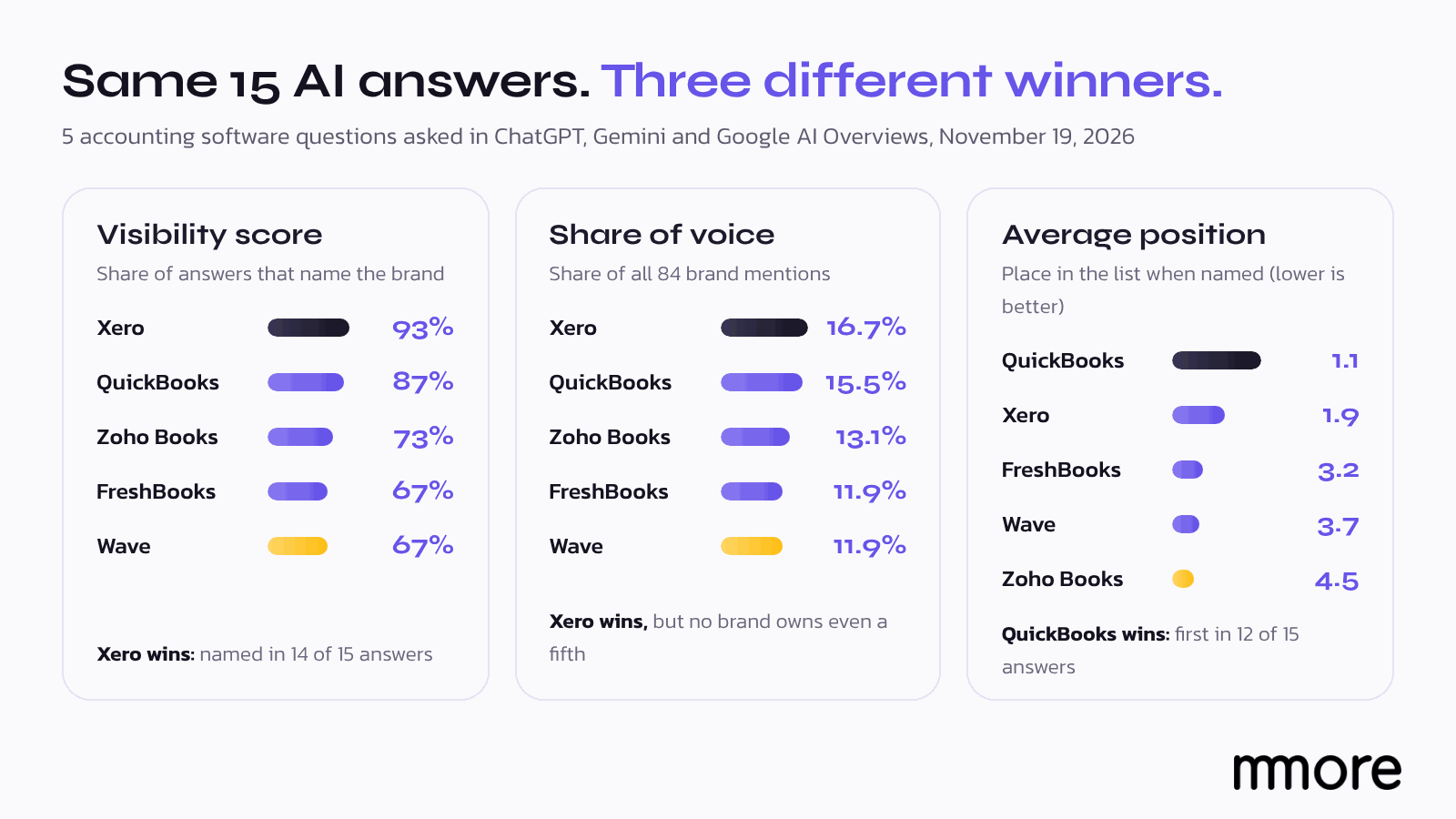
- In our accounting example, Xero appeared in more AI answers than QuickBooks, but QuickBooks was named first in 12 of 15. The winner depends on the metric.
- Track buyer prompts like “best accounting software for a SaaS company”, not your own brand name.
- GA4 misses much of the traffic AI tools send. Ask every lead how they found you.
What is AI search visibility?
AI search visibility is how often, how prominently and how positively AI tools like ChatGPT, Gemini, Perplexity and Google AI Overviews mention your brand when people ask questions in your category.
It matters because buyers now start their research there. In G2’s April 2026 Answer Economy report, a survey of 1,076 B2B software buyers, 51% said they start their research with an AI chatbot more often than with Google, up from 29% a year earlier.
Classic rank tracking can’t show this. There is no fixed “position 3” in an AI answer, and two people asking the same question can get two different lists. That is why AI visibility needs its own metrics.
The 5 AI visibility metrics that matter
The five AI visibility metrics that matter are visibility score, share of voice, average position, sentiment and citations. Most AI tracking tools, including Profound, Semrush and SE Ranking, report some version of each, though the exact formulas differ.
The 5 metrics, explained
Click a metric to see what it measures and what it tells you.
Visibility score
are you in the answer?
How it works
- Answers that mention your brand, divided by all answers tracked
- Example: named in 13 of 15 answers = 87%
- The best single number for “are AI tools recommending us?”
Watch out: it says nothing about where in the answer you appear.
Share of voice
your slice of all mentions
How it works
- Your brand mentions, divided by every brand mention in the same answers
- Example: 13 mentions out of 84 = 15.5%
- Shows how crowded your category is and who takes the space
Watch out: it drops when AI tools list more brands, even if you did nothing wrong.
Average position
how high you are listed
How it works
- Your place in the list, averaged over the answers that mention you
- Example: first in 12 answers and second in 1 = 1.1
- The closest thing AI search has to a ranking
Watch out: list order changes from run to run, so read it as a trend, not a fixed rank.
Sentiment
how you are described
How it works
- Positive mentions as a share of all positive and negative mentions
- Example: “easy to use” counts as positive, “can get expensive” as negative
- Tells you if being mentioned is actually helping
Watch out: a mention with a warning attached can cost you a sale.
Citations
the sources behind the answer
How it works
- The pages an AI tool links to or names as its sources
- Includes your own site, review sites, Reddit, YouTube and media
- Tells you where to work to change the answer
Watch out: most citations are not your website, so track all of them.
Here is how each metric is calculated, in one table you can bookmark:
| Metric | Formula | Question it answers |
|---|---|---|
| Visibility score | Answers mentioning you ÷ all answers | Do AI tools recommend us at all? |
| Share of voice | Your mentions ÷ all brand mentions | How much of the conversation do we own? |
| Average position | Average place in the list when mentioned | Are we the first pick or an afterthought? |
| Sentiment | Positive mentions ÷ (positive + negative mentions) | Is the way AI describes us helping or hurting? |
| Citations | Count of each source cited | Which pages shape the answer? |
These match the definitions in Profound’s glossary, the tool we use with clients. For example, Profound counts a brand named in 50 of 100 tracked responses as a 50% visibility score.
Worked example: which accounting brand is winning in AI search?
In a real example from our own data, Xero showed up in more AI answers than QuickBooks, but QuickBooks was ranked first far more often. Which brand is “winning” depends entirely on the metric you look at.
The data comes from our AI recommendation study. On November 19, 2026, we asked ChatGPT, Gemini and Google AI Overviews the same five accounting software questions from a browser in Calgary, one fresh chat per question. That gave us 15 answers with 84 brand mentions across 14 brands.
Three lessons come out of this small example:
- One metric hides the story. A Xero marketer looking only at visibility would think Xero leads. A QuickBooks marketer looking at position would think the same about QuickBooks. Both are right, and both are missing half the picture.
- Each AI tool tells a different story. Zoho Books appeared in all 5 Gemini answers but only 3 of 5 in ChatGPT and in Google AI Overviews. A team tracking only ChatGPT would underrate it.
- The long tail is real. Smaller brands like Rillet, Digits, Maxio and Acomba appeared once each. One mention in one answer is not a trend, which is why sample size matters.
This is a snapshot of one run on one day, so treat it as an illustration of the method, not a ranking of accounting software. Our full study of 60 questions across four AI tools is coming in a separate post.
How to set up AI visibility tracking, step by step
To set up AI visibility tracking, build a prompt list grouped by topic, add your competitors, pick the AI tools your buyers use, run each prompt many times, and log every citation. Then connect the results to leads.
- Build your prompt list by topic. Write the questions your buyers actually ask, grouped by service or product line. “Best payroll software for a 20-person company” belongs in a payroll topic, “Gusto alternatives” in a competitor topic.
- Add your competitors. Visibility only means something next to the brands you lose deals to. Add 3 to 5 of them to every topic.
- Pick the AI tools. Track at least ChatGPT, Google AI Overviews and Gemini. Add Perplexity, Claude or Copilot if your buyers use them.
- Run each prompt many times. A single run is a sample of one. Tools like Profound run every tracked prompt daily and average the results.
- Log every citation. Record which sources each answer uses, not just whether it links to you.
- Connect it to leads. Add “How did you find us?” to your forms and intake calls, with ChatGPT and other AI tools as options.
At mmore, we do this in Profound. Prompts are added by topic, so every topic has its own set of questions. We can check each prompt on its own and each topic as a whole, see where every competitor ranks, and see exactly which sources the AI tools cited for every answer.
AI visibility tracking: setup checklist
Tick each step as you set up tracking for your brand.
All 8 done. Your AI visibility numbers are ready to report.
Want to Know Where You Stand in AI Search?
4 mistakes that make AI visibility numbers useless
The most common AI visibility mistakes are checking one chat once, tracking your own brand name instead of buyer questions, watching only citations of your own website, and judging AI by Google Analytics traffic alone. Each one gives you numbers that look precise and mean very little.
1. Asking ChatGPT once and calling it a result
AI tools rarely give the same answer twice. In a January 2026 study by SparkToro and Gumshoe.ai, ChatGPT and Google’s AI features returned the same brand list less than 1% of the time across repeated runs of the same prompt.
Our own data shows the same thing across tools: ChatGPT, Gemini and Google AI Overviews named the same #1 brand on only 23 of 60 buying questions. So one screenshot of one chat proves nothing. Track how often you appear across many runs.
2. Tracking your brand name instead of buyer prompts
Prompts that include your brand name almost always mention you. “Is FreshBooks good for freelancers?” will talk about FreshBooks. That tells you nothing about whether you get recommended.
The prompts that matter are the ones a buyer types before they know you exist: “best accounting software for a freelancer in Canada”. Build most of your prompt list from these.
3. Only looking at citations of your own site
Most of what AI tools cite is not your website. In our study, Google AI Overviews cited Reddit in 49 of 60 answers and YouTube in 48 of 60.
That is why we track every citation for every prompt. If a competitor’s YouTube video keeps getting cited and our client has no video on that topic, we suggest they make one. Citations show you where to work to change the answer.
4. Judging AI by Google Analytics traffic alone
GA4 shows only part of what AI tools send you. Google added an AI Assistant channel to GA4 in May 2026, but Search Engine Journal found it undercounts: Perplexity still lands in Referral, AI mobile apps often arrive with no referrer and show up as Direct, and Google AI Overviews count as Organic Search.
Many buyers also read the AI answer, then search your name on Google later. That visit looks like branded search, not AI. A “How did you find us?” question on your forms catches what analytics misses.
Several of our clients asked new leads where they found them, and the answer was ChatGPT or Claude. Some clients now have a “How did you find us?” question on their forms, so we can see, at least roughly, how many leads come from AI tools.
Dmytro Klimchuk, CEO & Founder, mmore.agency
Which tools can measure AI search visibility?
Dedicated AI visibility tools like Profound measure mentions, position, sentiment and citations across AI tools. Google Search Console now shows impressions in AI Overviews and AI Mode for free, and GA4 shows some AI clicks. Each covers a different part of the picture.
| Tool | What it measures | What it misses |
|---|---|---|
| Profound (what we use) | Visibility score, share of voice, average position, sentiment and citations, by prompt and topic, across AI tools, with competitors | Leads and revenue, so pair it with your own lead tracking |
| Google Search Console | Impressions of your pages in AI Overviews and AI Mode, by page, country and device | Other AI tools, brand mentions without a link, competitors |
| Google Analytics 4 | Visits from AI tools that pass a referrer, in the AI Assistant channel | App visits with no referrer, Perplexity in Referral, AI Overviews in Organic |
| Manual checks | A quick look at how one AI tool answers one question today | Everything else: one run is not a measurement |
| “How did you find us?” | Leads that say an AI tool sent them | People who don’t remember or skip the question |
The Search Console report is new. Google introduced the generative AI performance reports in June 2026, with data starting May 18, 2026. They show impressions only, so they tell you that your pages appeared in AI Overviews or AI Mode, not how the answer described you.
How often should you report AI visibility?
Report AI visibility monthly, with a bi-weekly check for active campaigns. AI answers are noisy from day to day, so monthly trends tell you far more than weekly swings.
Our monthly client reports show visibility score, share of voice, average position, sentiment, and how each tracked prompt and topic moved. They also show which sources the AI tools cited, so the next month’s priorities come straight out of the data.
The 4P AI Visibility Check
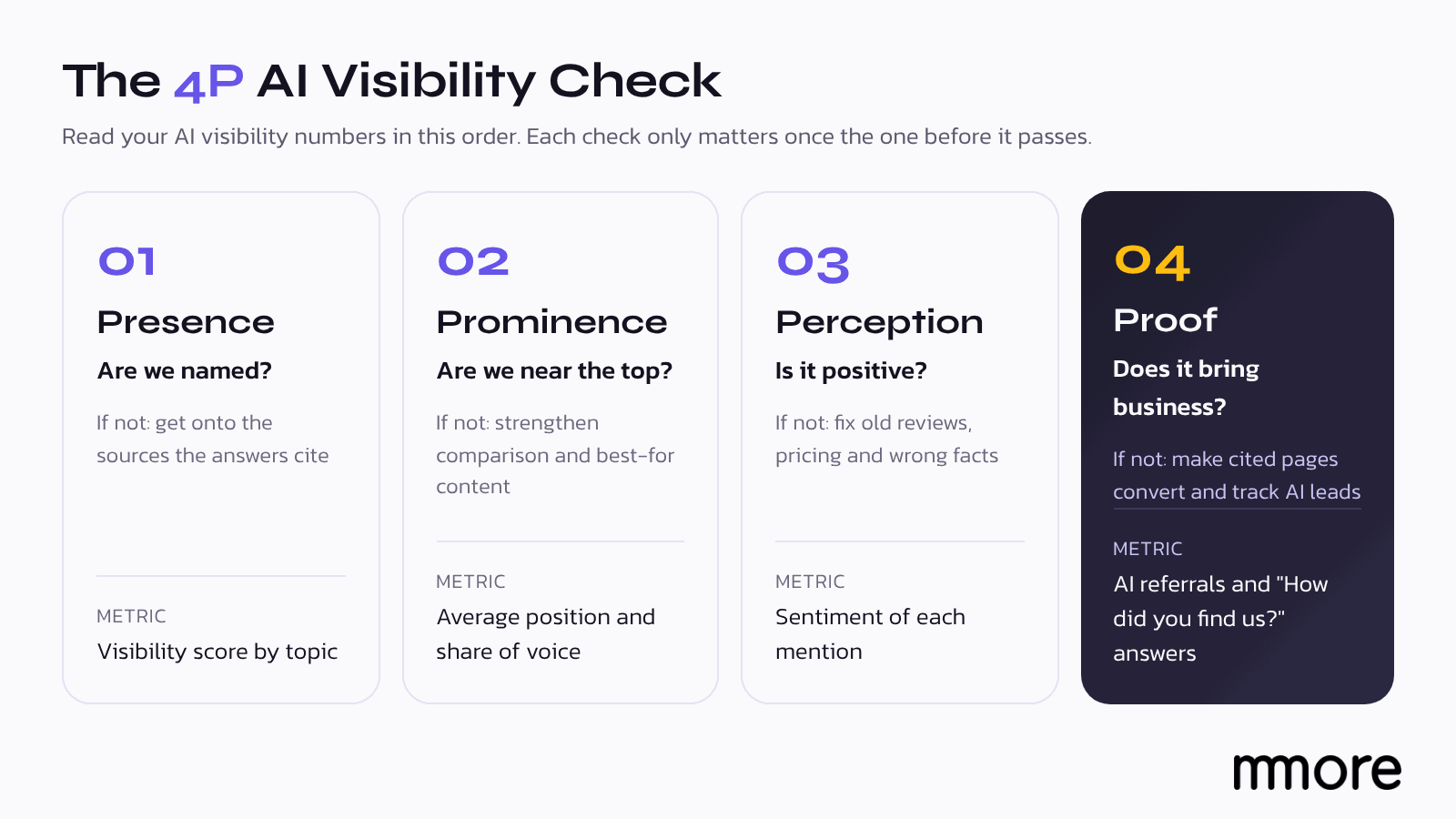
The 4P AI Visibility Check is the framework we use to read AI visibility numbers. It groups the five metrics into four questions, in order: Presence, Prominence, Perception and Proof.
| Check | Metric | What to do if it fails |
|---|---|---|
| Presence: are we named? | Visibility score by topic | Find which sources the answers cite and get your brand onto them |
| Prominence: are we near the top? | Average position and share of voice | Strengthen comparison and “best for” content, on your site and on cited third-party pages |
| Perception: is it positive? | Sentiment | Fix the source of the negative claim: old reviews, outdated pricing, wrong facts |
| Proof: does it bring business? | Citations, AI referrals and “How did you find us?” answers | Make cited pages convert, and track AI leads on every form |
Work through the checks in order. Improving sentiment means little if you are not named at all, and a top position means little if it brings no leads.
How mmore.agency measures AI visibility for clients
mmore.agency tracks AI visibility for every client in Profound, by topic and by prompt, with their main competitors next to them. We report visibility score, share of voice, average position, sentiment and citations every month, and bi-weekly when a campaign needs closer watching.
We don’t follow a fixed monthly checklist. Each month we review rankings, AI visibility, traffic and leads, then pick the priority tasks with the most impact. If a cited source is missing our client, getting them onto it becomes a task. Every month also includes a fixed amount of new and refreshed content, and a report on what we did and why.
Our SEO and AI search programs for SaaS and B2B companies cover this, starting from US$3,000 a month (about C$4,000). If you want to go from measuring to improving, read our guide on how to get recommended by ChatGPT, and our comparison of traditional SEO vs LLM optimization.
We are a Calgary-based SEO team working with clients across Canada and the US. If you are hiring help, our list of questions to ask an SEO agency includes how to check an agency’s AI search claims.
See How AI Tools Talk About You
Book a free website audit. We’ll check how ChatGPT, Gemini and Google AI Overviews answer your buyers’ questions, and what it would take to get named.
Frequently asked questions
What is a good AI visibility score?
There is no universal good score, because it depends on how crowded your category is and how many prompts you track. Compare yourself with your competitors on the same prompts instead. Being named in more answers than the brands you lose deals to is the goal.
How do I track brand mentions in ChatGPT for free?
You can run your buyer prompts in ChatGPT yourself and log the brands and sources in a spreadsheet. Run each prompt several times, ideally on different days, and count how often you appear. It works for a small prompt list, but it gets slow fast, which is why most teams move to a tracking tool.
Does Google Search Console show AI Overviews data?
Yes. Since June 2026, Search Console has generative AI performance reports that show impressions of your pages in AI Overviews and AI Mode, by page, country and device. They show impressions only, not how the AI answer described your brand.
How long does it take to improve AI visibility?
It depends on what is missing. Fixes to your own pages count once AI tools recrawl them. Getting onto the third-party sources AI tools cite, like review sites, Reddit threads and YouTube, takes longer, so plan on months of steady work rather than weeks.
Want AI visibility numbers you can trust?
Get a free website audit. We’ll show you how AI tools answer your buyers’ questions today, which sources they lean on, and what we’d do first. If mmore.agency isn’t the right fit, we’ll say so.
About the author
CEO & Founder, mmore.agency
Dmytro has spent 12+ years in SEO. He founded mmore.agency to give SaaS, B2B and local businesses SEO that ties to revenue: priorities picked from real data every month, content that Google and AI tools cite, and reports that show what actually moved.