 Dmytro KlimchukCEO & Founder, mmore.agencyExpertise
- SaaS and B2B SEO
- AI search (GEO and AEO)
- Local SEO and Google Maps
- Content strategy and SEO reporting
Last updated November 19, 2026
Hiring an SEO agency is easy. Hiring the right one is hard, because almost every agency sounds great on a sales call.
These are the questions to ask an SEO agency, or an AI SEO agency, before you sign anything. I run an agency, so I know which questions are easy to dodge and which answers tell you the most. For each one, you’ll see what a good answer sounds like and what should make you walk away.
This guide is for business owners and marketing leads comparing SEO proposals, whether you run a local business or a SaaS company.
Quick answer: Ask an SEO agency how it picks the work each month, what it reports, what results to expect and when, how it handles AI search, how long the contract is, and who owns your accounts and content if you leave. Good agencies answer plainly. Guarantees, long lock-ins and vague plans are the warning signs.
Key takeaways
- The best questions ask how an agency works, not just what it promises.
- Nobody can guarantee a #1 ranking on Google, and Google says so in its own hiring advice.
- You should own every account and every piece of content, and be able to leave with all of it.
- Ask any agency selling “AEO” or “GEO” how its advice lines up with Google’s official guidance on AI search.
- Month to month terms with about 30 days’ notice are a good sign that an agency expects to earn your business every month.
Why the right questions matter more in 2026
The right questions matter more now because SEO agencies sell more services than ever, including new “AI SEO”, “AEO” and “GEO” packages that are hard to judge from the outside.
Google updated its “Do you need an SEO?” guide in June 2026. It now tells business owners to check whether an agency’s AEO or GEO advice matches Google’s guidance on generative AI, and whether its tools do too. It still says nobody can guarantee a #1 ranking.
A wrong pick costs more than the monthly fee. It costs the months you lose before you notice nothing is working.
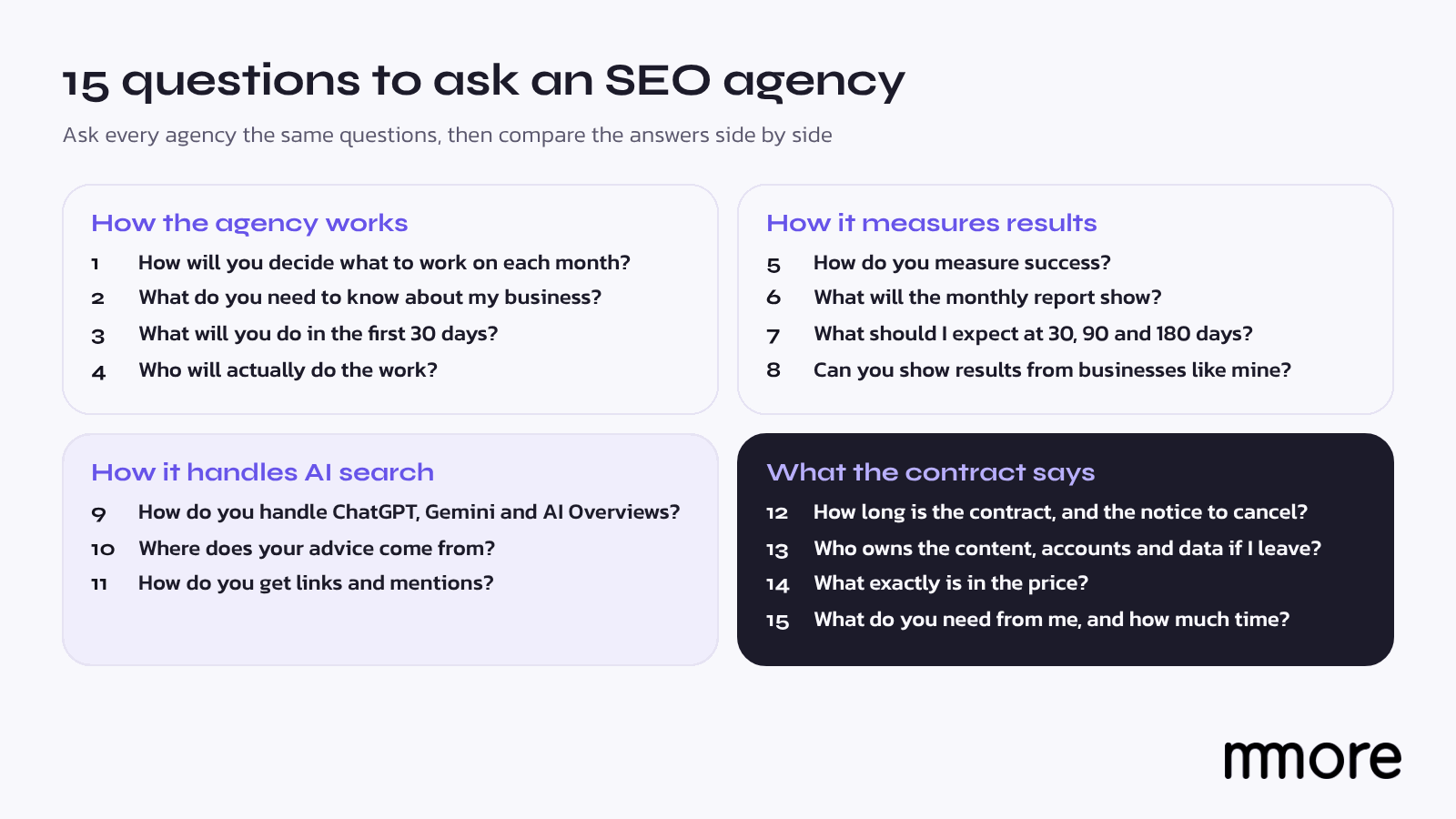
15 questions to ask an SEO agency
The questions are grouped by what they tell you: how the agency works, how it measures results, how it handles AI search, and what the contract says.
How the agency works
1. How will you decide what to work on each month?
This is the most useful question on the list. It shows whether the agency thinks or just follows a script.
Good answer: They review your rankings, traffic, leads and competitors each month, then pick the tasks with the biggest impact. Some months that’s a few big tasks, like new service pages. Other months it’s many small ones.
Red flag: The same fixed checklist every month, like “10 backlinks, 4 blog posts, 1 report”, no matter what your data shows.
2. What do you need to know about my business before you start?
An agency that doesn’t understand your customers will chase the wrong keywords.
Good answer: They ask about your best customers, your margins, your competitors and how people find you today. Many build an ideal customer profile before choosing a single keyword.
Red flag: They quote a price and a keyword list before asking a single question about your business.
3. What will you do in the first 30 days?
The first month shows how organized the agency is. Google’s own guidance says a good SEO shows interest in your business and how customers find you.
Good answer: A clear plan: access and tracking set up, a technical audit, a competitor check, a list of quick wins and a written plan for month one.
Red flag: “We’ll get started on optimization” with no detail.
4. Who will actually do the work?
Many agencies sell with a senior strategist and hand the work to someone else, sometimes outside the company.
Good answer: They name the people on your account, what each one does, and whether any work is outsourced.
Red flag: They avoid the question, or you can never speak with the person doing the work.
How the agency measures results
5. How do you measure success?
Rankings and traffic are useful, but they don’t pay the bills. Leads and sales do.
Good answer: They tie the work to business numbers: calls, form fills, demo requests or sales, with tracking set up so you can see where each one came from.
Red flag: Success means “rankings” for keywords nobody searches, or a traffic chart with no link to leads.
6. What will the monthly report show?
The report is how you check the agency’s work. A good one is short and clear.
Good answer: What was done, why it was chosen, and what moved: rankings for priority keywords, traffic, leads and AI visibility. Ask to see a sample report.
Red flag: A 40-page automated PDF full of charts, with no explanation of what was done or why.
7. What results should I expect at 30, 90 and 180 days?
SEO takes time, and an honest agency will tell you how much.
Good answer: Early technical fixes and quick wins in the first months, then steady growth. For most businesses, real results take several months, and newer sites take longer.
Red flag: Page one in 30 days, or a promise of a specific ranking.
8. Can you show me results from businesses like mine?
Google suggests asking for examples of past work. Industry experience shortens the learning curve.
Good answer: Real case studies with numbers, dates and a client you can verify. They’re also honest about what they haven’t done before.
Red flag: Screenshots with no names, dates or context, or no examples at all.
How the agency handles AI search
9. How do you handle AI search like ChatGPT, Gemini and AI Overviews?
More buyers now ask AI tools for recommendations, so AI visibility belongs in your SEO plan.
Good answer: They check how AI tools answer your customers’ key questions today, track it over time, and work on the sources those tools cite. They also say plainly that classic SEO is still the base.
Red flag: A separate, expensive “AI package” with no explanation of what it does, or a claim that AI search makes regular SEO pointless.
10. Where does your advice come from?
Google’s guide lists recommendations that don’t cite official Google documentation as a warning sign.
Good answer: They can point to Google’s documentation, like its guide to generative AI features in Search, and to their own tests. They say when something is their opinion.
Red flag: “Trust us, it works”, or tools described as “approved by Google”. Google doesn’t approve third-party SEO tools.
11. How do you get links and mentions?
Links and mentions still matter, but cheap ones can hurt you.
Good answer: Earned mentions: digital PR, useful content other sites want to cite, partner pages and real local listings.
Red flag: Bulk link packages, “1,000 backlinks for $99”, or private networks of sites they control.
What the contract says
12. How long is the contract, and how much notice do I give to cancel?
The contract tells you how confident the agency is that it can keep you happy.
Good answer: Month to month, or a short first term, with around 30 days’ notice to cancel and no exit fee.
Red flag: A 12-month lock-in with a large fee to leave early.
13. Who owns the content, accounts and data if I leave?
This is the question people forget, and the one they regret most.
Good answer: You own everything: the content, your Google Business Profile, Search Console, Analytics, the website and any tracking set up for you. You keep it all when you leave.
Red flag: The agency keeps the content, the profile or the data, or “rents” them to you.
14. What exactly is in the price, and are there extra fees?
Two agencies at the same price can deliver very different amounts of work.
Good answer: A clear monthly fee, what’s included, how much content you get, and any one-time costs written down before you sign.
Red flag: Setup fees, “tool fees” or required extras that only show up in the contract.
15. What do you need from me, and how much of my time?
SEO works best when the client takes part. Google’s guide also reminds you that you’re responsible for what any agency does on your site.
Good answer: A short list: access to accounts, a kickoff call, quick feedback on content and a monthly check-in. They tell you up front how many hours that usually takes.
Red flag: “Nothing, we handle it all”, which often means nobody checks the work.
Asking is only half the job. Score the answers so you can compare agencies side by side, not from memory.
Score an agency’s answers
After the call, mark each answer: good, vague or a red flag. Do one agency at a time, then start over for the next.
How the agency works
1. How you pick the work each month
2. What you need to know about my business
3. Your plan for the first 30 days
4. Who does the work
How it measures results
5. How you measure success
6. What the monthly report shows
7. Results at 30, 90 and 180 days
8. Results for businesses like mine
How it handles AI search
9. How you handle ChatGPT, Gemini and AI Overviews
10. Where your advice comes from
11. How you get links and mentions
What the contract says
12. Contract length and notice
13. Who owns content, accounts and data
14. What the price includes
15. What you need from me
0 / 30
Mark the first answer to start your score.
Red flag on the contract or on ownership. Fix that in writing before anything else, or walk away.
Strong answers. This agency is worth a serious look.
Mixed. Ask for the vague answers in writing before you decide.
Weak so far. Keep looking, or ask them to explain the red flags.
Comparing SEO Proposals? Get a Second Opinion
Red flags in SEO pitches and contracts
These are the warning signs I see most often in other agencies’ pitches and contracts, whether a business is choosing its first agency or switching.
Red flag check
Tick anything you heard on a sales call or read in a proposal.
No red flags yet. Keep going through the list.
One red flag. Ask the agency to explain it in writing.
Two or more red flags. Keep looking.
What should the first 30 days with an SEO agency look like?
The first 30 days should give you a clear picture of where you stand and a plan you understand. Here’s what we do in the first two to four weeks with every client:
The first 4 weeks with mmore
A typical order. Your own depends on what the data shows in week one.
Week 1
Get to know the business
- A deep dive into your business and niche: services, competitors and what makes you different
- An ideal customer profile: who you want more of, and what they search for
- Access to Google Analytics, Search Console, Google Business Profile and rank tracking
- A starting point for AI search: how ChatGPT, Gemini and Google AI Overviews answer your key questions today
Week 2
Find what holds you back
- Conversion tracking, so calls, forms and bookings tie to leads
- A technical audit of the site
- A competitor check: who ranks, and who AI tools recommend
Week 3
Fix the foundation
- Low-hanging fruit: pages close to page one, easy fixes and missing basics
- Foundational SEO fixes
- Priority keywords mapped to pages
Week 4
Plan and start building
- The content plan starts, along with the first priority tasks
- A written plan for the month ahead
- The first report: what was done and why
If an agency can’t tell you what its first month looks like, it probably doesn’t have one.
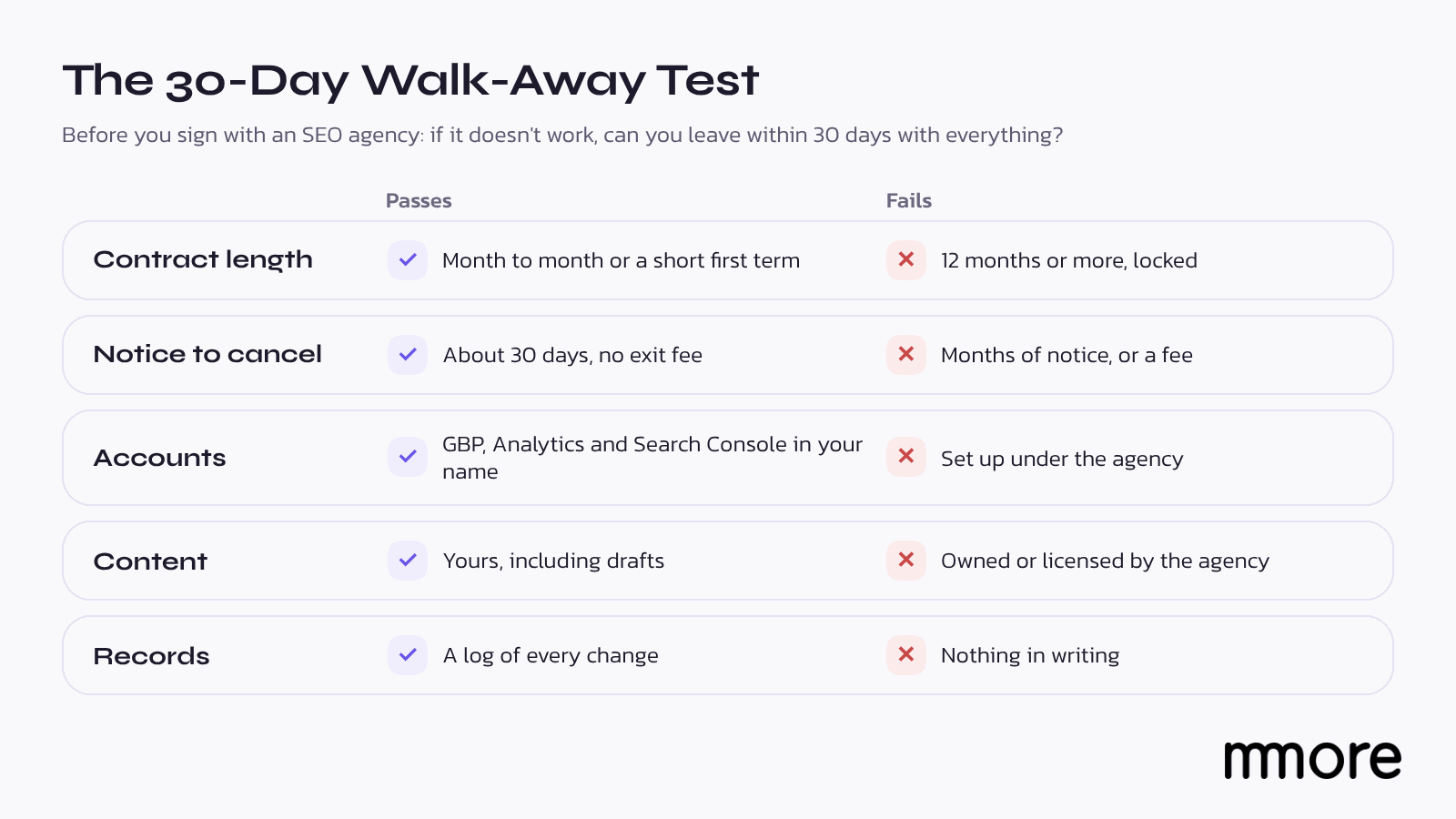
The 30-Day Walk-Away Test
Before you sign, ask one question: if this doesn’t work, can I leave within 30 days and take everything with me? We call this the 30-Day Walk-Away Test.
| Check | Passes | Fails |
|---|---|---|
| Contract length | Month to month or a short first term | 12 months or more, locked |
| Notice to cancel | About 30 days, no exit fee | Months of notice, or a fee |
| Accounts | GBP, Analytics and Search Console in your name | Set up under the agency |
| Content | Yours, including drafts | Owned or licensed by the agency |
| Records | A log of every change | Nothing in writing |
An agency that passes has nothing to hide. One that fails on two or more checks is asking you to trust it before it has earned that trust.
How mmore.agency answers these questions
mmore.agency works month to month, with usually 30 days’ notice to cancel. You own everything we create and every account we work in: the content, your Google Business Profile, Search Console and Analytics.
We don’t use a fixed monthly checklist. Each month we review your rankings, Google Maps positions, AI visibility, traffic and leads, then pick the priority tasks with the most impact. Every month also includes a fixed amount of new and refreshed content, and a report on what we did, why, and what moved.
Local SEO starts from C$2,000 a month, and SaaS and B2B programs from US$3,000 (about C$4,000). Our guides to how much SEO costs in Calgary and SaaS SEO pricing show how that compares, and our comparison of in-house vs agency SEO helps if you’re not sure an agency is the right choice at all.
We’re a Calgary SEO and AI search agency working with clients across Canada and the US. If you’re still checking whether your current agency is doing its job, start with our list of signs your SEO isn’t working.
The question I wish I heard more often is ‘how will you decide what to work on next month?’ If an agency can’t answer that without pulling out a fixed package, they’re selling a checklist, not a strategy.
Dmytro Klimchuk, CEO & Founder, mmore.agency
Ask Us All 15 Questions
Book a free website audit. We’ll show you where you stand in Google and AI search, and answer every question on this list in writing.
Frequently asked questions
How many SEO agencies should I talk to before hiring?
Talking to three agencies is usually enough. It gives you a feel for prices and approaches without taking weeks. Ask all three the same questions so you can compare the answers side by side. If you’re in Calgary, our comparison of 11 Calgary SEO agencies is a good place to find them.
Is it normal for SEO agencies to require a 12-month contract?
Some agencies do, but it isn’t required to do good work. Many good agencies work month to month or after a short first term. If an agency asks for 12 months, ask why, and what happens if you want to leave early.
What access should I give an SEO agency?
Give access to what the agency needs, in your own accounts: Search Console, Google Analytics, Google Business Profile and the website. Google suggests read-only Search Console access while an agency is only auditing your site. Add the agency as a user instead of sharing your password.
What is the difference between an SEO agency and an AI SEO agency?
An AI SEO agency also works on how AI tools like ChatGPT, Gemini and Google AI Overviews mention your business. In practice the two overlap a lot, because AI search leans on the same basics: crawlable pages, clear content and mentions on trusted sites. Ask how the AI part is measured.
When should I fire my SEO agency?
Consider leaving if you can’t see what was done, results haven’t moved after six months with no clear reason, or the agency won’t answer the questions above. Make sure you have access to all your accounts and content before you give notice.
Want straight answers before you sign?
Get a free website audit. We’ll show you what’s working, what isn’t, and what we’d do first, with no lock-in. If mmore.agency isn’t the right fit, we’ll say so.
About the author
CEO & Founder, mmore.agency
Dmytro has spent 12+ years in SEO. He founded mmore.agency to give SaaS, B2B and local businesses SEO that ties to revenue: priorities picked from real data every month, content that Google and AI tools cite, and reports that show what actually moved.