

 Dmytro KlimchukCEO & Founder, mmore.agencyExpertise
- SaaS and B2B SEO
- AI search (GEO and AEO)
- Local SEO and Google Maps
- Content strategy and SEO reporting
Last updated November 22, 2026
Most SaaS SEO strategies start in the wrong place. They begin with a blog calendar and broad “what is” articles, then wait months for traffic that rarely turns into trials or demos.
This guide is for SaaS founders and marketing leads planning their SEO for 2026. It shows a different order: start with the pages buyers read right before they choose, then work up the funnel. The plan is built on what B2B buyers ask AI tools first and on which pages AI tools cited in our own study of 240 software answers.
Quick answer: A strong SaaS SEO strategy for 2026 starts with bottom-of-funnel pages: alternatives and comparison pages, “best [category] for [audience]” pages, use case pages, integration pages and a clear pricing page. These match the prompts buyers type into AI tools first, and they sit closest to a signup. Blog content comes after.
Key takeaways
- In G2’s 2026 survey, 64% of B2B software buyers started their AI research with a category or competitor prompt.
- Each prompt type maps to one page type, which gives you a build order: category, competitor, requirements, ecosystem, then budget.
- In our study of 240 AI answers, Perplexity cited the website of a brand it recommended in 49 of 60 answers, so your own pages can become the source.
- Zapier’s blog was the only site all four AI tools cited, which shows how far good “best tools” content travels.
- Plan the first 90 days around 15 to 25 bottom-of-funnel pages and measure them by signups and demos, not traffic.
Why should a SaaS SEO strategy start at the bottom of the funnel?
A SaaS SEO strategy should start at the bottom of the funnel because that is where buyers compare and decide. A person searching “Asana alternatives” is already shopping. A person searching “what is project management” may be years away from buying anything.
Buying behavior backs this up. G2’s 2026 Buyer Behavior Report found that evaluation is now the longest stage of the software buying journey, ahead of research for the first time. Buyers spend their time comparing vendors, and comparison pages are what they read while doing it.
AI tools make the shift sharper. In G2’s Answer Economy research, 51% of B2B software buyers said they start research in an AI chatbot more often than in Google. Those first prompts are rarely “what is” questions.
What do B2B buyers ask AI tools first?
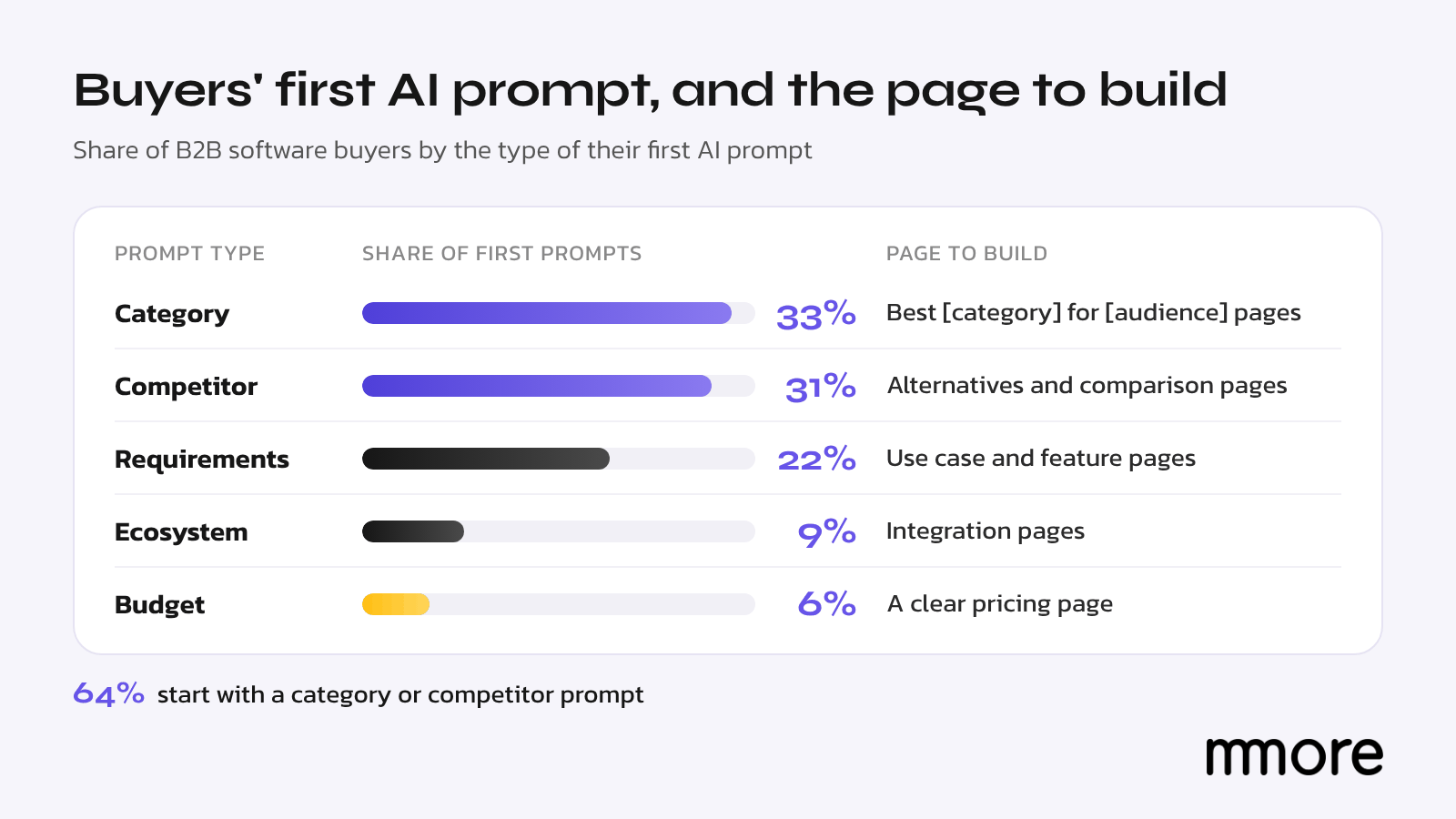
B2B buyers mostly open with category and competitor prompts. When G2 asked 1,076 buyers to describe their first AI prompt, 33% said it named a software category and 31% named a competitor. Requirements prompts came next at 22%, then ecosystem prompts at 9% and budget prompts at 6%.
What B2B buyers ask AI tools first, and the page that answers it
Share of B2B software buyers by the type of their first AI prompt, from G2’s 2026 survey of 1,076 buyers. Pick a prompt type.
Category prompts: 33% of buyers
Example prompt
- “Best project management software for agencies”
Page to build
- A “best [category] for [audience]” page for each audience you serve, with honest criteria and where your product fits
Competitor prompts: 31% of buyers
Example prompt
- “Asana alternatives for a growing startup”
Page to build
- An alternatives page for each big competitor, plus “you vs them” pages for the two or three you meet most in deals
Requirements prompts: 22% of buyers
Example prompt
- “CRM with built-in email sequences for a small sales team”
Page to build
- Use case and feature pages that answer one job, with screenshots, limits and who it is not for
Ecosystem prompts: 9% of buyers
Example prompt
- “Accounting software that integrates with Shopify”
Page to build
- An integration page for each tool your buyers already use, with what syncs and how to set it up
Budget prompts: 6% of buyers
Example prompt
- “Best payroll software under $50 a month”
Page to build
- A public pricing page with plans, limits and what costs extra, so AI tools quote your real price
Source: G2, The Answer Economy, survey of 1,076 B2B software buyers, March 2026. Example prompts are from mmore’s 60-question AI study or written as illustrations.
What this means for your plan: two prompt types cover almost two thirds of first questions, so category and competitor pages come first. When we plan SaaS programs, we map every page on the roadmap to one of these prompt types before anything gets written.
The Five-Prompt Page Plan: which SaaS pages to build first
The Five-Prompt Page Plan matches each type of buyer prompt to the page that answers it, in order of how many buyers start there. It turns a vague “do more content” goal into a short list of pages with a clear reason for each one.
| Prompt type | Share of first prompts | Page to build |
|---|---|---|
| Category | 33% | Your category page and one page per audience or industry |
| Competitor | 31% | Alternatives and comparison pages |
| Requirements | 22% | Use case and feature pages |
| Ecosystem | 9% | Integration pages |
| Budget | 6% | A clear pricing page |
Three rules keep the plan honest:
- One prompt, one page. Don’t make one page chase “alternatives”, “pricing” and “integrations” at once. Each page answers one question well.
- Start with the competitors you meet in deals. Ask sales which three names come up most, and build those alternatives pages first.
- Publish real facts. Prices, limits and integrations change. Date your comparisons and update them, or AI tools will repeat old numbers.
For the format of competitor pages, see our guide to SaaS comparison pages. If you have hundreds of integrations or use cases, our post on programmatic SEO for SaaS explains when templates are worth it.
Want a Bottom-of-Funnel Page Plan for Your SaaS?
Why do bottom-of-funnel pages also win AI citations?
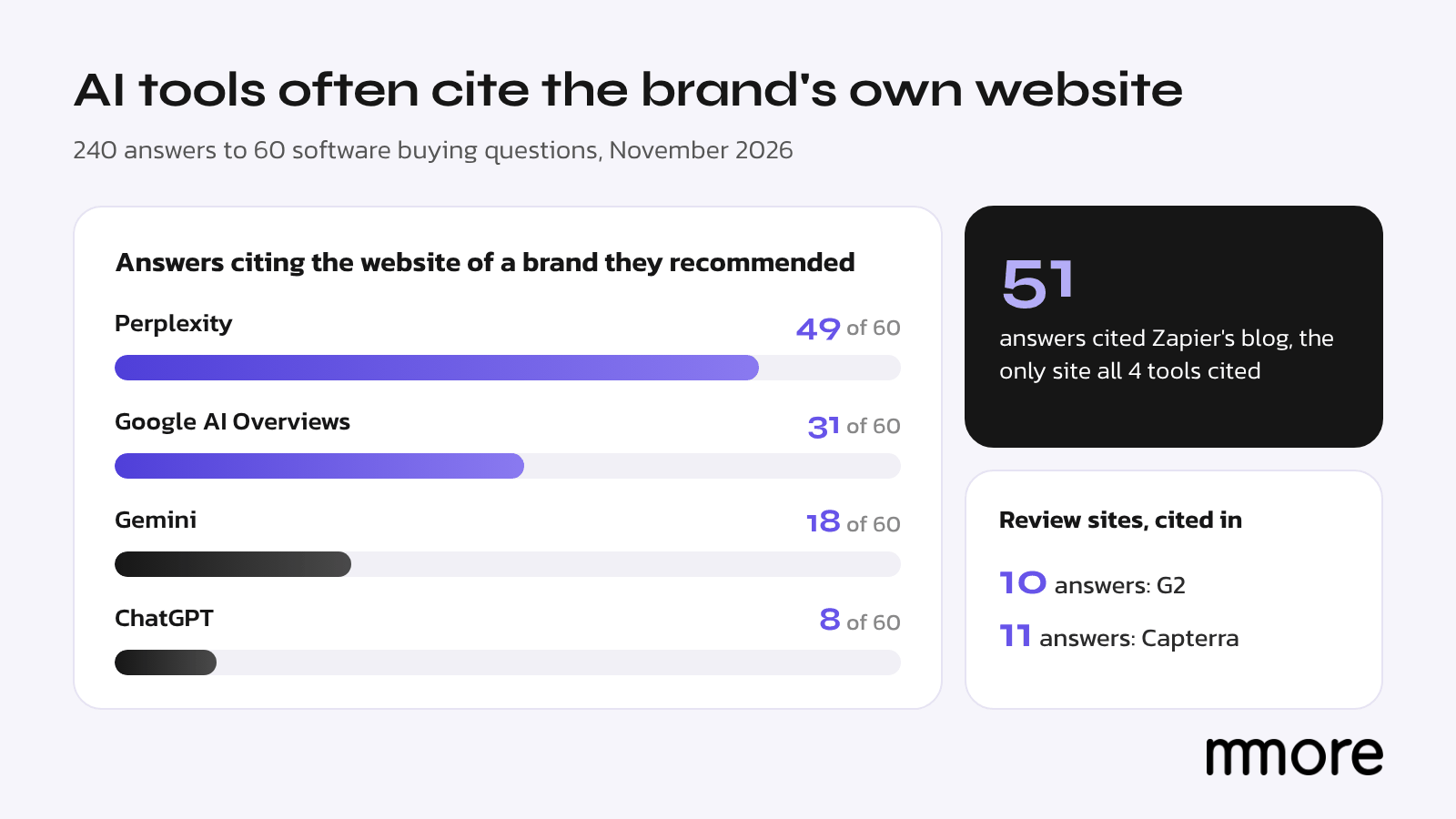
Bottom-of-funnel pages win AI citations because AI tools often quote the software companies’ own pages when buyers ask what to buy. In our November 2026 study of AI brand recommendations, we asked ChatGPT, Gemini, Perplexity and Google AI Overviews 60 software buying questions and logged 1,104 sources behind the 240 answers. The short version is below; the full breakdown of what sources AI uses is in its own post.
| AI tool | Answers citing a recommended brand’s own site | Sources per answer |
|---|---|---|
| Perplexity | 49 of 60 | 9.1 |
| Google AI Overviews | 31 of 60 | 5.8 |
| Gemini | 18 of 60 | 2.3 |
| ChatGPT | 8 of 60 | 1.2 |
Three patterns matter for your strategy:
- Your own pages can be the source. Perplexity and Google AI Overviews often quoted the websites of the brands they recommended. Clear pricing, feature and comparison pages give them something to quote.
- “Best tools” content travels. Zapier’s blog was cited in 51 of the 240 answers and was the only site all four tools cited. A software company’s own roundups became a source for the whole category.
- Review sites mattered less than expected. G2 was cited in 10 answers and Capterra in 11. They are worth keeping current, but they are not the whole answer.
The tools also disagreed a lot: all four put the same brand first on only 22 of the 60 questions. That is why we check visibility in several tools, as explained in our guide on how to measure AI search visibility.
How do you roll out bottom-of-funnel pages in 90 days?
A focused team can publish 15 to 25 bottom-of-funnel pages in 90 days if it works in a set order: map prompts, build competitor pages, add use case and integration pages, then measure. Each stage feeds the next, so the order matters more than the speed.
A 90-day bottom-of-funnel rollout
Four stages for a SaaS company starting from a blog-heavy site. Click a stage to see what to do and when it is done.
Weeks 1 to 2: Map the prompts
What to do
- List 20 to 30 buyer prompts across the five types, using sales calls, demo notes and lost-deal reasons
- Ask them in ChatGPT, Gemini, Perplexity and Google, and note who gets named and which pages get cited
- Match each prompt to a keyword and check who ranks today
Done when
- Every prompt has one page assigned to it
- You know which competitors show up most
Weeks 3 to 6: Build competitor pages
What to do
- Publish alternatives pages for the competitors you meet most in deals
- Add one or two “you vs them” pages where you win often
- Keep claims fair and dated, with a clear “who should pick them” section
Done when
- Pages are indexed and linked from your homepage and product pages
- Sales can send them to prospects
Weeks 7 to 10: Add use case and integration pages
What to do
- Write one page per job your product does well, with real screenshots
- Build integration pages for the tools your customers connect most
- Update your pricing page so limits and extras are clear
Done when
- Each page targets one prompt type
- Pages show up in Search Console impressions
Weeks 11 to 13: Measure and expand
What to do
- Track signups, demos and trials from the new pages, not just traffic
- Re-run the same prompt set and compare who AI tools name now
- Pitch the third-party lists and review sites AI tools cite in your category
Done when
- Report shows pipeline next to rankings
- The next 90 days are picked from this data
Keep the product team close. The best SaaS pages have real screenshots, honest limits and details only your team knows. Google’s guidance on helpful, people-first content asks for exactly that: first-hand expertise and content written for the reader, not for rankings.
When should a SaaS company move up the funnel?
Move up the funnel once your main bottom-of-funnel pages are live, indexed and bringing signups or demos. At that point, educational content has a job: it attracts earlier buyers and links them to pages that already convert.
Good middle-of-funnel topics come straight from your bottom-of-funnel pages. If your alternatives page wins deals on reporting, a guide to choosing reporting software for agencies will feed it. Write those guides next, and link every one of them to a page that sells.
Common SaaS SEO strategy mistakes
- Starting with a glossary. Definitions rarely lead to a signup, and AI Overviews and chatbots often answer them without a click.
- Hiding the pricing. If you don’t publish prices, AI tools guess them. In our check of AI agency recommendations, one company was quoted three different prices.
- Unfair comparison pages. Pages that only praise you lose trust with buyers. Say who each competitor is better for.
- Measuring traffic only. A SaaS SEO report should show trials, demos and pipeline next to rankings.
The first question I ask a SaaS founder is which three competitors come up on sales calls. Those three alternatives pages are where I want to start, because the people reading them are already choosing. Blog posts can wait until the pages that sell are live.
Dmytro Klimchuk, CEO & Founder, mmore.agency
How mmore.agency builds SaaS SEO strategies
mmore.agency builds SaaS SEO and AI search strategies from the bottom of the funnel up, starting from US$3,000 a month (about C$4,000). Programs run month to month with about 30 days’ notice, and you own all content and accounts.
We don’t sell a fixed checklist. Every month we look at rankings, AI answers for your buyer prompts, traffic, signups and demos, then choose the highest-impact work. Early on, that is usually alternatives, comparison, use case and integration pages. Later it shifts to updates, mentions on the sites AI tools cite and content that feeds your best pages.
- Priorities from data: the next pages and fixes, picked each month.
- A fixed amount of content: new bottom-of-funnel pages and updates to pages that already rank.
- Clear reporting: what we did, why, and what moved in Google, AI answers and your pipeline.
Our research on how to get recommended by ChatGPT and on SaaS SEO pricing shows how we work. Learn more about our SaaS SEO and AI search services and B2B SEO programs, run by a Calgary search agency working with software companies across Canada and the US.
Get Your Five-Prompt Page Plan
Book a free website audit. We’ll check your buyer prompts in AI tools, look at your current pages and show which bottom-of-funnel pages to build first.
Frequently asked questions
What are bottom-of-funnel pages for SaaS?
Bottom-of-funnel pages are the pages buyers read right before they choose a product. For SaaS, that means alternatives and comparison pages, “best [category] for [audience]” pages, use case pages, integration pages and the pricing page. They target searches and prompts from people who are already shopping.
How many bottom-of-funnel pages does a SaaS company need?
In our experience, most SaaS companies need 15 to 40 to start: one alternatives page per main competitor, a few comparison pages, one page per key use case and one per major integration. Companies with hundreds of integrations may need templates, which is a separate decision.
Should a SaaS startup still write blog posts?
Yes, but after the bottom-of-funnel pages exist. Blog posts work best when each one answers a real buyer question and links to a page that converts. Posts with no path to a product page rarely pay off for an early-stage company.
How long does a bottom-of-funnel SaaS SEO strategy take to work?
Google says SEO usually takes four months to a year to show results. Bottom-of-funnel pages are the best place to look for the first signups, because the people reading them are already comparing products. Track signups and demos from these pages from the first month.
Ready to plan your bottom-of-funnel pages?
Get a free website audit. We’ll show which buyer prompts you already win, which pages you are missing and what we would build first. If mmore.agency isn’t the right fit, we’ll tell you.
About the author
CEO & Founder, mmore.agency
Dmytro has spent 12+ years in SEO. He founded mmore.agency to give SaaS, B2B and local businesses SEO that ties to revenue: priorities picked from real data every month, content that Google and AI tools cite, and reports that show what actually moved.